
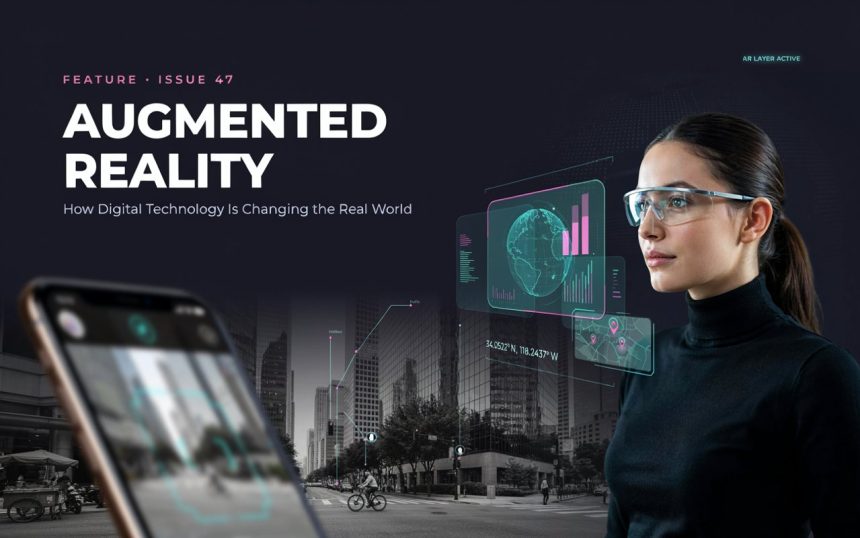
Augmented Reality is no longer just a futuristic idea seen in science-fiction movies. It has quietly become part of everyday technology, appearing in mobile apps, games, shopping tools, navigation systems, education platforms, and professional workplaces. Instead of taking you completely into a digital environment, it adds computer-generated information to the world you can already see.
That difference is important. If Virtual Reality is like stepping into another world, Augmented Reality is more like putting a digital layer over the world around you. You remain connected to your surroundings while technology adds useful images, information, directions, or interactive objects.
As smartphones, cameras, sensors, artificial intelligence, and wearable devices continue to improve, this technology is becoming more capable. But how does it actually work, where is it being used, and what could it mean for everyday life? Let’s take a closer look.
What Is Augmented Reality?
Augmented Reality, commonly known as AR, is a technology that places digital content into a person’s view of the physical world. That content might be a 3D object, text, animation, map, instruction, product preview, or interactive graphic.
Unlike a traditional computer application, AR attempts to connect digital information with your surroundings.
For example, imagine pointing your phone’s camera at an empty section of your living room and seeing a virtual sofa appear on the screen. You could move the phone around the room and view the sofa from different angles. The furniture is not physically there, but the software makes it appear as though it belongs in the space.
That is the basic idea behind this technology.
AR does not necessarily replace reality
This is one of the easiest ways to distinguish it from other immersive technologies. The physical environment remains visible, while digital elements are added to it.
A navigation application might display arrows over a street view. A shopping app could show how a table would look in your home. A learning application might place a 3D model of the human heart in front of you.
In each case, the real world remains the foundation of the experience.
How Does Augmented Reality Work?
Although an AR experience can look simple, several technologies usually work together behind the scenes.
A device needs to understand what the camera is seeing and where the user is located in relation to the environment. It then places digital content in an appropriate position.
Cameras and sensors
Cameras capture information about the surrounding environment. Other sensors can provide information about movement, direction, and position.
Modern smartphones contain several sensors that help applications understand how the device is moving.
Computer vision
Software examines visual information to identify surfaces, objects, shapes, and other environmental features. This allows digital content to appear more naturally connected to the physical surroundings.
For instance, if an application recognizes the floor, it can place a virtual object on that surface rather than making the object appear to float randomly.
Motion tracking
The system needs to keep track of the device as you move. If you walk around a virtual object, the digital image needs to adjust accordingly.
Without accurate tracking, an AR object could appear to slide, shake, or lose its position.
Software and processing
Applications combine information from cameras and sensors with digital models and instructions. More powerful processors allow these tasks to happen quickly enough for an experience to feel responsive.
Artificial intelligence is also becoming increasingly useful because it can help systems recognize objects, understand scenes, and respond to users.
Augmented Reality vs. Virtual Reality
People often use the terms Augmented Reality and Virtual Reality together, but they provide different experiences.
Virtual Reality generally attempts to place the user inside a completely computer-generated environment. A headset blocks much of the physical surroundings and replaces them with digital content.
AR takes a different approach.
Virtual Reality
- Creates a digital environment.
- Usually requires a dedicated headset.
- Can completely replace the user’s surroundings.
- Commonly used for gaming, simulations, training, and immersive experiences.
Augmented Reality
- Adds digital content to the physical environment.
- Can work through smartphones, tablets, smart glasses, and other devices.
- Keeps the real world visible.
- Useful for navigation, shopping, education, entertainment, and practical assistance.
There is also another category called mixed reality, which can combine physical and digital elements in more interactive ways.
A simple analogy helps: Virtual Reality is like walking into a movie, while AR is like watching the real world with an intelligent set of digital annotations appearing around you.
Augmented Reality in Everyday Life
You may already use AR without thinking about it.
Modern smartphones have made the technology much more accessible because many people already carry the necessary camera, sensors, display, and processing power in their pockets.
Social media effects
Many social platforms use face tracking to place virtual masks, glasses, makeup, hats, animations, and other effects over a person’s face.
The experience may look like a simple camera filter, but sophisticated tracking technology is working underneath it.
Navigation
AR navigation can display directions directly over a camera view. Instead of simply seeing a traditional map, you might see an arrow indicating which direction to walk.
This can be particularly useful in unfamiliar areas.
Translation
Some applications can recognize written words through a camera and display translated text over the original scene. This can help travelers understand signs, menus, labels, and other information.
Home design
Furniture and interior design applications can allow users to visualize products in their own rooms before buying them.
These examples show that AR does not always need futuristic glasses. A smartphone can already provide useful experiences.
Augmented Reality in Gaming and Entertainment
Gaming helped introduce many people to the possibilities of AR.
Instead of keeping the game entirely inside a screen, AR games can connect digital characters and objects with physical surroundings.
A player might walk around a neighborhood while interacting with virtual elements displayed through a smartphone.
Interactive environments
AR can transform ordinary spaces into game environments. A park, room, street, or building can become part of the experience.
This creates opportunities for games based on exploration, puzzles, fitness, treasure hunting, and social interaction.
Entertainment beyond gaming
The possibilities also extend to concerts, sporting events, movies, museums, and live attractions.
Imagine attending a sports match and using a device to view additional player information, statistics, or replays while watching the action.
At a museum, visitors might point a device toward an artifact and see additional information or a reconstructed version of how it originally looked.
The physical experience remains important, but digital information makes it richer.
How AR Is Changing Shopping and Retail
Shopping is one of the areas where this technology can solve a very practical problem.
Online shopping is convenient, but there is always uncertainty. Will that sofa fit in the room? Will those glasses look good on your face? Does that particular color match the rest of the furniture?
AR can reduce some of that uncertainty.
Virtual product previews
Customers can use their phones to see digital versions of products in their surroundings.
Furniture companies can allow shoppers to preview tables, chairs, beds, or decorations inside their homes.
Beauty brands can provide virtual previews of makeup or hairstyles.
Eyewear applications can show how different frames might look on a user’s face.
A better buying experience
The main advantage is visualization.
Instead of imagining what a product might look like, customers can get a more immediate idea of its appearance and scale.
That can make online shopping more engaging and may help consumers feel more confident about certain purchases.
However, a virtual preview should not be treated as a perfect representation. Lighting, screen quality, camera limitations, and physical dimensions can all affect how a product appears.
The Role of AR in Education
Education could benefit significantly from technology that makes information easier to visualize.
Some subjects are difficult to understand simply by reading text or looking at two-dimensional diagrams.
Consider the human body.
A textbook can show a diagram of the heart. An AR application could allow students to view a three-dimensional heart, examine its different parts, and understand how those structures relate to one another.
Science
Students can explore models of cells, organs, planets, molecules, animals, and physical structures.
History
Historical buildings and objects can be reconstructed digitally. Students might be able to see how a location looked hundreds or thousands of years ago.
Geography
Maps can become more interactive by displaying terrain, landmarks, weather information, and geographical features.
Practical learning
Technical students can also receive step-by-step visual instructions while working with equipment.
This approach can make lessons more interactive, although it should complement teachers and established learning methods rather than replace them.
Healthcare and Professional Uses
Healthcare is another field where AR has interesting potential.
Medical professionals often need to understand complicated physical structures and procedures. Digital overlays could provide additional information without requiring the user to look away from the task.
Medical education
Students can examine three-dimensional anatomical models and explore structures from different angles.
Surgical assistance
In specialized settings, digital information may potentially be displayed alongside a professional’s view of the patient. Such systems require careful testing, accuracy, and professional oversight.
Training
AR can provide visual instructions for certain procedures or equipment.
Beyond healthcare, similar ideas can be applied to other professional environments.
Engineers, technicians, mechanics, construction workers, and factory employees can potentially receive instructions directly within their field of view.
For example, a technician repairing a machine could see digital indicators showing where specific components are located.
This can reduce the need to constantly look at a separate manual or computer screen.
AR in Manufacturing, Design, and Business
Businesses are exploring AR because it can connect digital information with physical tasks.
In manufacturing, workers may need to assemble products containing hundreds or thousands of components. Visual instructions can make complicated processes easier to follow.
Product development
Designers can examine digital models before physical prototypes are created.
Maintenance
Technicians can receive information about equipment while standing directly in front of it.
Training
New employees can practice tasks with visual guidance before working independently.
Remote support
An expert in another location could potentially guide a worker by identifying parts of a machine and providing instructions through a shared visual experience.
This could be particularly useful when specialized expertise is not immediately available on-site.
The broader idea is simple: information becomes more useful when it appears at the moment and location where someone needs it.
Benefits of Augmented Reality
Why is so much attention being given to this technology?
The answer comes down to its ability to connect information with context.
Better visualization
Three-dimensional objects and overlays can make complicated information easier to understand.
Convenience
Users can access information while remaining focused on their surroundings.
Improved engagement
Interactive content can be more engaging than static images or text.
Practical assistance
Workers can receive instructions while completing physical tasks.
Shopping confidence
Customers can preview certain products before buying them.
Learning opportunities
Students can interact with educational content in ways that traditional materials may not provide.
Accessibility
Digital guidance could potentially help people understand environments, instructions, and objects more easily.
However, the value depends heavily on how well an AR application is designed. Adding digital graphics simply because the technology allows it does not automatically make an experience better.
Good AR should solve a problem, provide useful information, or create meaningful interaction.
Challenges, Privacy, and Limitations
Like every emerging technology, AR comes with challenges.
One of the biggest concerns is privacy.
AR devices may use cameras and sensors to understand their surroundings. If wearable devices become common, they could potentially collect information about people, places, movements, and environments.
Privacy questions
Who owns the information collected by an AR device?
How long is it stored?
Can companies use environmental data for advertising?
Could facial recognition be used without someone’s knowledge?
These questions will become increasingly important as wearable systems become more advanced.
Distraction
Another concern is attention.
Imagine walking through a busy street while looking at digital instructions instead of paying attention to traffic. Technology that is designed to help can become dangerous if it distracts users from important physical cues.
Technical limitations
AR systems can also struggle with poor lighting, complicated environments, inaccurate tracking, limited battery life, or insufficient processing power.
Cost and accessibility
Advanced hardware may be expensive, which can prevent some people and organizations from benefiting from it.
There is also the issue of digital accessibility. Not everyone has access to the latest smartphone or wearable device.
These limitations do not make AR unsuccessful, but they show why responsible development is essential.
The Future of Augmented Reality
The next stage of AR could look very different from today’s smartphone-based experiences.
One major possibility is the continued development of lightweight smart glasses.
Instead of holding a phone in front of your face, information could appear directly within your field of view.
Imagine walking through an unfamiliar city and seeing navigation arrows appear naturally along the street. You might look at a restaurant and see its opening hours. You could receive reminders without reaching into your pocket.
That sounds convenient, but the technology will need to become comfortable, reliable, affordable, and respectful of privacy before it can become truly mainstream.
Artificial intelligence and AR
Artificial intelligence could make future experiences more responsive.
An intelligent assistant could recognize objects and provide useful information about them. It could understand what you are looking at and respond to questions about your surroundings.
Wearable computing
As devices become smaller, AR could move beyond phones and tablets.
Glasses, head-mounted displays, and other wearable products may eventually become normal computing tools.
Work and communication
Remote collaboration could also change. Instead of looking at a two-dimensional video call, colleagues might interact with shared digital models or information placed within a physical workspace.
A more connected environment
Ultimately, the goal may not be to make people spend more time staring at screens. It could be to make digital information available without requiring constant attention to a traditional display.
That distinction could determine whether AR becomes genuinely useful or simply another source of digital distraction.
Is Augmented Reality the Future of Technology?
AR has already demonstrated that digital information does not have to remain trapped inside a screen.
From shopping and gaming to education, healthcare, navigation, design, and industrial work, it can bring information closer to the situations where people actually need it.
The technology still has plenty of challenges to overcome. Hardware needs to become more comfortable, software needs to become more reliable, and companies need to address privacy and responsible data use.
Even so, the basic concept is remarkably powerful.
Instead of asking people to leave the real world behind, AR attempts to make the real world more informative.
That may be its greatest strength. The future may not be about choosing between physical and digital experiences. Instead, the two could increasingly work together, creating a world where information is available around us without completely replacing the environment we live in.
Conclusion
Augmented Reality is changing the relationship between physical spaces and digital information. What began largely as an experimental concept has become a practical tool used in entertainment, shopping, education, navigation, healthcare, manufacturing, and many other areas.
Its future will depend on more than better cameras or faster processors. The technology must also be comfortable, affordable, useful, secure, and respectful of people’s privacy.
If those challenges are handled properly, AR could become one of the most natural ways we interact with technology. Rather than constantly looking down at a screen, we may eventually be able to access useful digital information while keeping our attention on the world around us.
Frequently Asked Questions
1. What is Augmented Reality?
Augmented Reality is a technology that adds digital information, images, animations, or three-dimensional objects to a person’s view of the physical environment.
2. What devices can be used for Augmented Reality?
AR can work through smartphones, tablets, smart glasses, head-mounted displays, and specialized professional equipment. The exact capabilities depend on the hardware and software being used.
3. Is Augmented Reality the same as Virtual Reality?
No. AR adds digital elements to the real world, while VR generally replaces the user’s surroundings with a computer-generated environment.
4. How is Augmented Reality used in everyday life?
Common examples include camera effects, interactive games, navigation, product visualization, virtual furniture placement, translation tools, and educational applications.
5. What will Augmented Reality look like in the future?
Future systems may rely more heavily on lightweight smart glasses, artificial intelligence, improved environmental awareness, and hands-free digital information. The technology could become increasingly integrated into work, education, communication, shopping, and daily activities.