

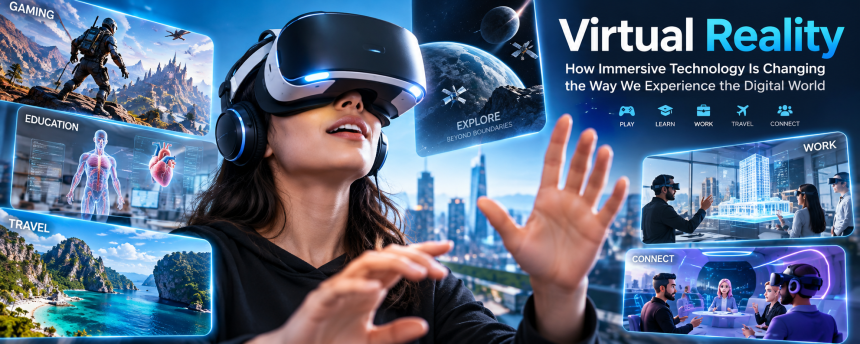
Virtual Reality has moved far beyond the world of science fiction. What once seemed like an idea reserved for futuristic movies is now available through headsets that people can use at home, in schools, workplaces, entertainment centers, and even professional training environments.
But what exactly makes this technology so interesting? In simple terms, it creates a computer-generated environment that allows you to look around, move through a digital space, and interact with objects as though you were actually there. Instead of watching something happen on a flat screen, you become part of the experience.
The technology is developing quickly, and its potential reaches well beyond gaming. From education and healthcare to tourism, design, communication, and business, immersive experiences are changing how people interact with digital content. This guide explains how the technology works, where it is being used, its advantages and limitations, and what the future may look like.
What Is Virtual Reality?
Virtual Reality is a technology designed to create a simulated three-dimensional environment. A headset typically covers your eyes and displays separate images for each eye, creating a sense of depth. Sensors track movements such as turning your head, looking up, or looking down, allowing the digital environment to respond naturally.
Think of it like stepping through a doorway into a computer. A normal screen gives you a window into a digital world, while an immersive headset attempts to put you inside that world.
Depending on the system, users may be able to walk around, pick up virtual objects, communicate with other people, explore locations, or complete interactive tasks.
Several components usually work together to create this experience:
- A headset provides the visual display.
- Motion sensors track head and body movement.
- Controllers allow interaction with digital objects.
- Cameras can monitor the surrounding environment.
- Audio systems provide directional sound.
- Software generates and manages the virtual environment.
The quality of the experience depends on how effectively these components work together.
How Does Virtual Reality Work?
At first glance, a headset may look like a simple screen placed in front of your eyes. In reality, several technologies operate simultaneously.
The headset displays slightly different images to your left and right eyes. Your brain combines these images and interprets them as a three-dimensional scene. This is one of the main reasons digital objects can appear to have depth.
Motion tracking is equally important. When you turn your head, sensors detect the movement and update the displayed scene almost immediately. If you look toward a virtual doorway, for example, the system changes your viewpoint just as a real environment would.
Tracking and movement
Modern systems can track more than head movement. Some can recognize hand movements, body position, and the location of controllers. This allows you to interact with virtual objects instead of simply looking at them.
Sound and immersion
Visuals are only part of the experience. Spatial audio can make sounds appear to come from particular directions. If something happens behind you, you may hear it from behind. Small details like this can make an environment feel considerably more convincing.
Rendering and processing
A computer, console, smartphone, or standalone headset processes the digital environment. More powerful hardware can generally create richer scenes, smoother movement, and more detailed objects.
The goal is simple: the faster the system can respond to your movements, the more natural the experience feels.
The Main Types of Virtual Reality
Not every immersive system works in exactly the same way. There are several categories, ranging from simple experiences to highly interactive environments.
Fully immersive systems
These provide the strongest sense of presence. The user’s vision is largely occupied by the digital environment, while motion tracking and controllers allow interaction.
Standalone headsets have become particularly attractive because they do not always require a powerful computer or complicated setup.
Computer-connected systems
Some headsets connect to a gaming computer or workstation. These systems can take advantage of stronger processors and graphics hardware, making them suitable for demanding applications.
The trade-off is that they can be more expensive and less convenient.
Mobile-based experiences
Earlier forms of immersive technology used smartphones placed inside special viewers. These products were relatively affordable, although their capabilities were limited compared with modern dedicated headsets.
Location-based experiences
Some entertainment centers provide large spaces where people can physically move while interacting with digital environments. These experiences can support multiplayer activities and more advanced tracking.
Virtual Reality in Gaming and Entertainment
Gaming remains one of the most recognizable uses of immersive technology.
Traditional games place the player in front of a display. An immersive game can make the player feel as though they have entered the environment themselves.
Imagine playing a horror game. Instead of seeing a dark hallway on a television, you can look around that hallway yourself. If you hear something behind you, you can physically turn around to investigate. That simple difference can dramatically change the emotional experience.
Interactive gameplay
Motion controllers allow players to use their hands. They can swing virtual objects, operate equipment, solve puzzles, or interact with characters.
Sports, racing, adventure, fitness, strategy, and simulation games can all benefit from this approach.
Movies and storytelling
Entertainment companies are also exploring immersive storytelling. Instead of controlling a character, viewers can sometimes experience a scene from within the environment.
This creates new challenges for creators because audiences can look in different directions. Directors cannot always control exactly what viewers see.
Social experiences
Virtual spaces can also allow people to meet as digital avatars. Friends who live far apart can communicate, play games, attend events, or explore environments together.
How It Is Transforming Education
Education is another area where immersive experiences can be extremely useful.
A textbook can explain how an ancient city looked. A video can show a reconstruction. An immersive environment can allow students to explore that city themselves.
This approach can make abstract subjects easier to understand.
History lessons
Students can explore historical environments, examine virtual objects, or experience reconstructed locations.
Science education
Learners can explore the human body, examine molecules, visit distant planets, or conduct simulated experiments.
Technical training
Students preparing for technical careers can practice procedures without immediately working with expensive equipment.
Learning through experience
One of the strongest benefits is active participation. Instead of simply reading about a process, learners can interact with it.
That does not mean immersive technology should replace teachers or traditional materials. Rather, it can become another tool that makes certain lessons more engaging.
Healthcare and Medical Applications
Healthcare is one of the most promising areas for immersive technology.
Medical professionals can use digital simulations for education and training. Students can study anatomy through interactive three-dimensional models, while professionals can practice procedures in controlled environments.
Medical training
Simulated environments can allow learners to repeat difficult procedures without putting a real patient at risk.
Pain management
Immersive experiences have also been investigated as a way of distracting patients during certain uncomfortable procedures. By focusing attention on another environment, some people may experience less awareness of discomfort.
Rehabilitation
Interactive exercises can encourage patients to perform specific movements as part of rehabilitation programs.
Mental health applications
Researchers and professionals have explored immersive environments for certain therapeutic approaches, including controlled exposure exercises.
These applications require appropriate professional oversight. The technology itself is a tool, not a replacement for qualified medical care.
Business, Workplaces, and Professional Training
Businesses are increasingly interested in immersive technology because it can provide practical training without requiring employees to experience real-world risks.
For example, a company could create a simulated industrial environment where workers practice responding to an emergency.
This can be especially useful when mistakes in the real world would be expensive or dangerous.
Employee training
New workers can learn procedures in a simulated environment before handling real equipment.
Product design
Engineers and designers can examine three-dimensional models and identify potential problems before manufacturing begins.
Remote collaboration
Teams in different locations can meet inside shared digital environments. Rather than discussing a three-dimensional product through a flat video call, participants can potentially examine the same virtual model together.
Retail and marketing
Businesses can also create interactive demonstrations that allow customers to explore products before making purchasing decisions.
Virtual Tourism and Real-World Exploration
Travel is another fascinating application.
Why should you need to travel thousands of miles just to understand what a location looks like? While immersive technology cannot fully reproduce the physical experience of travel, it can provide a useful preview.
Museums, historical sites, hotels, tourism organizations, and educational institutions can create virtual tours.
You might explore a famous landmark, walk through a museum exhibition, or view a destination before deciding whether to visit.
This can also improve accessibility for people who cannot easily travel because of physical, financial, or geographic limitations.
However, a digital visit should not be confused with actual travel. You cannot reproduce every smell, temperature, texture, social interaction, or spontaneous experience through a headset.
Benefits and Advantages
There are several reasons why this technology continues to attract attention.
Greater immersion
The biggest advantage is the feeling of presence. Users can become more deeply involved than they might be with conventional screens.
Safe experimentation
Training environments can reproduce risky situations without exposing people to the same physical danger.
Interactive learning
Students can manipulate objects and explore environments rather than simply receiving information.
Remote experiences
People can participate in activities that would otherwise require travel.
Better visualization
Three-dimensional models can make complex designs and structures easier to understand.
Engagement
Interactive experiences can capture attention in ways that passive media sometimes cannot.
These advantages explain why the technology is being explored across such a wide range of industries.
Limitations and Challenges
Despite its potential, immersive technology is not perfect.
One major challenge is cost. High-quality equipment can still represent a significant investment, particularly when additional computers, accessories, software, or specialized environments are required.
Comfort is another concern. Wearing a headset for extended periods may feel uncomfortable for some users. Weight, heat, limited battery life, and physical adjustment can affect the experience.
Motion discomfort
Some people experience nausea, dizziness, headaches, or discomfort when visual movement does not perfectly match physical movement. Better hardware and software have reduced the problem, but it has not disappeared entirely.
Privacy
Headsets can collect information about movement, surroundings, and interactions. As these systems become more sophisticated, privacy and data protection will remain important concerns.
Social considerations
Spending too much time in digital environments can also raise questions about balance and real-world interaction.
The technology is powerful, but using it responsibly matters just as much as improving the hardware.
What Is the Future of Virtual Reality?
Where does the technology go from here?
Future systems are likely to become smaller, lighter, more comfortable, and easier to use. Improvements in displays, tracking, processors, batteries, artificial intelligence, and wireless communication could make immersive experiences feel increasingly natural.
One important development is the blending of physical and digital environments. Instead of completely blocking out the real world, future devices may allow virtual objects to appear within your actual surroundings.
This could create new possibilities for education, work, entertainment, shopping, communication, and home use.
Artificial intelligence may also make digital environments more responsive. Virtual characters could become better at understanding conversations and responding naturally.
Imagine entering a virtual classroom where an intelligent tutor can answer questions, demonstrate concepts, and adjust lessons based on your progress. Or picture a virtual design studio where you can change a product simply by asking for modifications.
The long-term possibilities are difficult to predict, but one thing is clear: immersive computing is likely to become part of a much broader digital ecosystem.
Is Virtual Reality Worth Exploring?
For many people, the answer depends on what they want to do with it.
If you enjoy interactive games, immersive entertainment, creative applications, fitness experiences, or digital exploration, a headset may offer something genuinely different from a conventional screen.
For students and professionals, the value may come from training and visualization rather than entertainment.
However, buying expensive equipment simply because the technology is popular may not make sense. Consider what you actually want to use it for, how often you expect to use it, and whether the available software supports those interests.
The best technology is not necessarily the one with the longest specification sheet. It is the one that solves a real problem or provides an experience you genuinely value.
Conclusion
Virtual Reality has developed from a futuristic concept into a practical technology with applications across entertainment, education, healthcare, business, training, tourism, and communication. Its biggest strength is its ability to make digital experiences feel more personal and interactive.
There are still challenges involving cost, comfort, privacy, accessibility, and motion discomfort. Yet continued advances in hardware and software are gradually addressing many of these limitations.
Ultimately, the technology is not simply about escaping into another world. It is about finding new ways to learn, create, communicate, practice, and experience information. As immersive systems become more accessible, they may become another important way we interact with the digital world.
Frequently Asked Questions
1. What is Virtual Reality?
Virtual Reality is a technology that creates computer-generated three-dimensional environments that users can explore and interact with using specialized equipment such as headsets and controllers.
2. Is Virtual Reality only used for gaming?
No. It is also used for education, healthcare, professional training, product design, tourism, communication, fitness, simulation, and other applications.
3. Can Virtual Reality make people feel sick?
Some users experience dizziness, nausea, headaches, or eye strain, particularly during experiences with rapid movement. Modern systems have introduced improvements intended to reduce these effects.
4. Do you need a powerful computer to use Virtual Reality?
Not always. Some modern headsets operate independently, while others connect to computers for additional processing power and more demanding applications.
5. What will Virtual Reality look like in the future?
Future devices are expected to become more comfortable, compact, powerful, and responsive. Greater integration with artificial intelligence and mixed-reality technology could also create more natural interactions between physical and digital environments.