
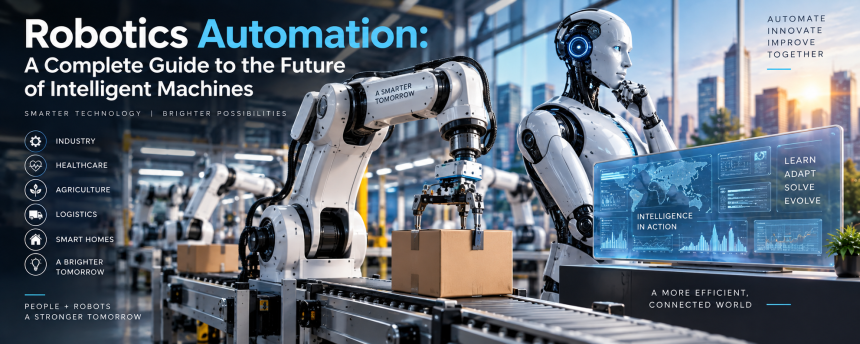
Robotics automation is no longer something that belongs only in science-fiction movies or highly advanced laboratories. Today, intelligent machines are becoming part of everyday life. They help build cars, organize warehouses, assist doctors, clean floors, deliver products, and perform tasks that once depended entirely on human effort.
You may not always notice it, but automation is already working around you. When a package moves through a modern warehouse, when a factory assembles a product, or when a hospital uses advanced equipment to support a medical procedure, automated systems may be involved behind the scenes.
But what does this technological shift really mean for ordinary people? Will machines replace human workers, or will they simply change the way people work? How do robots understand their environment and perform tasks?
The answers are more interesting than they may seem. Intelligent machines are not simply replacing human effort. In many situations, they are becoming powerful tools that help people work faster, safer, and more efficiently. This article explores how robotics automation works, where it is used, its advantages and challenges, and how it may shape the future.
What Is Robotics Automation?
Robotics automation combines machines, software, sensors, and control systems to perform tasks with little or no direct human involvement.
A robot is a machine designed to carry out specific actions. Automation refers to using technology to complete processes automatically. When these two ideas come together, machines can perform repetitive or complex tasks based on programmed instructions and information from their surroundings.
The basic concept is simple: a machine receives information, processes it, and performs an action.
For example, an industrial robotic arm may receive instructions about how to assemble a product. Sensors help it understand its position, while software controls its movements.
Other automated systems may use cameras and artificial intelligence to identify objects, make decisions, or adjust their actions.
These systems can be found in many environments, including:
- Factories
- Warehouses
- Hospitals
- Farms
- Offices
- Homes
- Restaurants
- Transportation networks
The goal is usually to improve efficiency, accuracy, safety, or productivity.
However, not every robot looks like a human. In fact, most machines used in modern industries are designed for very specific jobs. A robotic arm, warehouse vehicle, surgical system, or cleaning machine may all look completely different because each one is built for a particular purpose.
How Do Automated Robots Work?
Robotic systems work by combining several important technologies. Each component plays a different role, but they must work together for the machine to perform its task successfully.
The Mechanical Structure
The physical structure allows a machine to move and interact with its environment.
Depending on its purpose, it may have:
- Robotic arms
- Wheels
- Tracks
- Joints
- Grippers
- Cameras
- Sensors
For example, a robotic arm used in manufacturing may have several joints that allow it to move in different directions.
A warehouse machine may use wheels to travel through storage areas.
The design depends on the task. A machine built to lift heavy objects will look very different from one designed to clean floors.
Sensors and Information
Sensors act like the senses of an automated system.
They help machines collect information about their surroundings.
Common sensors can detect:
- Distance
- Movement
- Temperature
- Pressure
- Light
- Position
- Objects
Cameras can also provide visual information.
For example, a machine may use cameras to identify a product on a conveyor belt. Sensors can help determine its location, while software decides what action to take.
Software and Control Systems
The software acts like the decision-making system.
It processes information and sends instructions to different parts of the machine.
Imagine a robotic system as an orchestra. The mechanical parts are the instruments, the sensors provide information about the environment, and the software acts like the conductor, coordinating everything so the system performs correctly.
Without effective software, even an advanced machine would not know how to respond to information.
Different Types of Robotics Automation
Robotic systems come in many forms because different industries have different needs.
Industrial Robots
Industrial robots are widely used in manufacturing environments.
They may perform tasks such as:
- Welding
- Painting
- Cutting
- Assembly
- Packaging
- Material handling
These machines are particularly useful for repetitive work.
For example, a robotic arm can perform the same movement thousands of times with a high level of consistency.
This does not mean human workers are unnecessary. People are still needed to design systems, manage operations, maintain equipment, solve problems, and perform tasks that require creativity or complex judgment.
Collaborative Robots
Collaborative robots, often called cobots, are designed to work closer to humans.
Traditional industrial machines may operate inside restricted areas for safety reasons. Collaborative systems are designed with features that allow safer interaction in shared workspaces.
They may help workers with:
- Lifting
- Assembly
- Sorting
- Packaging
- Repetitive tasks
These systems can support workers rather than completely replacing them.
Mobile Robots
Mobile robots can move from one location to another.
They are commonly used in warehouses and logistics centers.
Some can navigate using sensors, cameras, and digital maps.
They may transport products, materials, or equipment through large facilities.
This reduces the amount of time workers spend walking long distances and carrying heavy items.
Robotics Automation in Manufacturing
Manufacturing is one of the industries most closely connected with robotics.
Factories have used automated machines for many years, but modern systems are becoming more flexible and intelligent.
Improving Production
Automated equipment can perform repetitive actions at high speed.
For example, machines can:
- Assemble components
- Apply paint
- Weld metal
- Move products
- Inspect finished items
This can improve production speed and consistency.
A machine does not become tired in the same way a person does. It can repeat a programmed action for long periods when properly maintained.
However, machines still require supervision and maintenance.
Improving Quality Control
Modern factories increasingly use cameras and sensors to inspect products.
Computer vision systems can identify certain defects or inconsistencies.
For example, an automated inspection system may detect:
- Missing parts
- Surface damage
- Incorrect labels
- Assembly problems
This can help manufacturers identify issues earlier in the production process.
The result can be less waste and better product consistency.
Automation in Warehouses and Logistics
Online shopping has increased the demand for faster and more efficient delivery systems.
Warehouses must manage thousands or even millions of products.
This is where automated machines can make a major difference.
Moving Products Efficiently
Mobile machines can transport goods between different areas of a warehouse.
Instead of workers walking long distances to collect items, automated vehicles may bring products closer to employees.
This can improve productivity and reduce physical strain.
Sorting and Packaging
Automation can also assist with sorting and packaging.
Machines can help organize products based on size, destination, or other information.
Some systems use robotic arms to pick up items and place them into packages.
This is especially useful in large facilities that process a high number of orders.
The Role of Human Workers
Despite increased automation, warehouses still rely heavily on people.
Workers manage operations, handle unusual situations, maintain equipment, and perform tasks that machines cannot easily complete.
The future is likely to involve greater cooperation between humans and intelligent machines rather than a complete replacement of human workers.
Healthcare and Medical Robotics
Healthcare is another important area where robotics is making a difference.
Medical systems can help healthcare professionals perform certain tasks with greater precision and control.
Surgical Assistance
Robotic surgical systems can assist trained surgeons during certain procedures.
These systems do not simply perform surgery independently. Medical professionals remain responsible for making decisions and controlling the procedure.
The technology can provide improved precision and control in appropriate situations.
Hospital Automation
Hospitals also use automated systems for tasks such as:
- Delivering supplies
- Transporting equipment
- Cleaning areas
- Managing laboratory processes
By handling routine activities, machines can help staff focus more of their time on patient care.
Support for Elderly Care
Robotic systems may also support older adults.
Some technologies can assist with mobility, reminders, monitoring, or communication.
These systems are not intended to replace human relationships or professional caregivers. Instead, they can provide additional support.
Robotics Automation in Agriculture
Farming is changing as digital technology becomes more common.
Agricultural operations often involve large areas, repetitive tasks, and changing environmental conditions.
Automation can help farmers manage these challenges.
Automated Farming Equipment
Modern agricultural machines may assist with:
- Planting
- Harvesting
- Monitoring crops
- Removing weeds
- Irrigation
Sensors can collect information about soil, weather, and plant conditions.
This data can help farmers make more informed decisions.
Precision Agriculture
Precision agriculture focuses on using technology to manage resources more accurately.
Instead of treating an entire field exactly the same way, farmers may use data to understand differences across different areas.
For example, automated systems may help identify where plants need more attention.
This can potentially reduce waste and improve efficiency.
A Smarter Approach to Farming
Imagine managing a large farm without any technology. It would be like trying to understand an entire city by walking through every street every day.
Sensors, automated equipment, and aerial systems provide farmers with a broader and more detailed view.
They can support better decisions while reducing unnecessary work.
Artificial Intelligence and Smart Machines
Artificial intelligence is becoming increasingly important in robotics automation.
Traditional machines follow a fixed set of instructions. AI can help systems process more information and respond to changing conditions.
Machine Learning
Machine learning allows software to identify patterns in data.
For example, an automated system may learn to recognize differences between objects after analyzing many examples.
This can improve capabilities such as:
- Object recognition
- Quality inspection
- Navigation
- Prediction
- Pattern detection
Computer Vision
Computer vision allows machines to interpret visual information.
A camera captures an image, while software analyzes what appears in that image.
This can help automated systems recognize objects and understand their surroundings.
For example, a warehouse robot may use visual information to navigate around obstacles.
Smarter Decision-Making
AI can help machines make better decisions based on available information.
However, intelligent systems are not perfect.
They can make mistakes, especially when they encounter situations that were not considered during development.
This is why testing, monitoring, and human oversight remain important.
Robots in Homes and Everyday Life
Robotics automation is not limited to large companies and industrial facilities.
Many people already use automated devices in their homes.
Common examples include:
- Robotic vacuum cleaners
- Smart appliances
- Automated lawn equipment
- Voice-controlled devices
- Home monitoring systems
Making Daily Tasks Easier
Automated devices can handle repetitive household activities.
For example, a robotic vacuum can move through a home and clean floors with limited human involvement.
Smart systems may also control lighting, heating, or security.
The purpose is not necessarily to create a fully automated home. Instead, these technologies can make everyday tasks more convenient.
The Smart Home of the Future
Future homes may include more connected devices that communicate with one another.
For example, a home system could potentially adjust energy use based on daily routines.
A cleaning device might operate when people are away.
While this offers convenience, it also raises questions about privacy and data security.
The more connected our homes become, the more important it becomes to protect personal information.
The Benefits of Robotics Automation
The growing use of automated systems is driven by several important advantages.
Improved Efficiency
Machines can perform repetitive tasks quickly and consistently.
This can help organizations complete work in less time.
Greater Accuracy
Automated systems can perform precise movements and measurements.
This can be useful in manufacturing, healthcare, and other industries where accuracy is important.
Improved Safety
Machines can sometimes perform tasks in dangerous environments.
For example, robots may be used in areas with:
- Extreme temperatures
- Hazardous materials
- Heavy equipment
- Dangerous heights
This can reduce the amount of risk faced by human workers.
Increased Productivity
Automation can help organizations process larger amounts of work.
For example, a warehouse may move and organize products more efficiently with automated support.
Support for Workers
Automation can reduce the amount of repetitive or physically demanding work people must perform.
Workers may then focus more on tasks that require communication, creativity, decision-making, and problem-solving.
Challenges and Concerns
Although robotics automation offers many benefits, it also creates important challenges.
Job Changes
One of the biggest concerns is employment.
Some tasks previously performed by humans may become automated.
This can change the types of skills workers need.
At the same time, new roles may be created in areas such as:
- Programming
- Maintenance
- Engineering
- System management
- Data analysis
The challenge is helping workers adapt to changing job requirements.
Education and training will become increasingly important.
High Initial Costs
Advanced robotic systems can be expensive to purchase and install.
Organizations may also need to invest in:
- Training
- Maintenance
- Software
- Infrastructure
Small businesses may find it difficult to afford large automated systems.
However, technology often becomes more affordable over time.
Technical Problems
Machines can fail.
Software can experience errors.
Sensors can provide incorrect information.
For this reason, organizations need reliable maintenance and backup systems.
Automation does not eliminate problems. Instead, it changes the types of problems that need to be solved.
Privacy and Security
Connected machines collect and share information.
This creates potential security concerns.
Organizations must protect systems from unauthorized access and misuse.
Privacy is also important when automated systems collect information about people.
How Robotics Will Change the Future of Work
The workplace of the future may look very different from today’s workplace.
Rather than completely replacing humans, intelligent machines are likely to change how people perform their jobs.
Humans and Machines Working Together
Many future workplaces may use a combination of human skills and machine capabilities.
Machines are generally good at:
- Repetition
- Speed
- Precision
- Data processing
Humans are generally strong at:
- Creativity
- Communication
- Empathy
- Complex judgment
- Adaptability
Combining these strengths can create more effective workplaces.
A machine may perform repetitive calculations or physical movements, while a person makes important decisions.
The Importance of New Skills
As automation grows, workers may need to develop new skills.
These could include:
- Digital literacy
- Technical knowledge
- Problem-solving
- Data understanding
- Communication
Learning may become a continuous process rather than something that ends after school.
The ability to adapt may become one of the most valuable skills of the future.
The Future of Robotics Automation
The future of robotics automation will likely involve machines that are more intelligent, flexible, and connected.
Several developments may shape the next generation of automated systems.
More Intelligent Machines
Future systems may use advanced AI to understand complex environments.
Instead of following only fixed instructions, they may adapt to changing situations.
Greater Collaboration
Machines may increasingly work alongside people.
Collaborative systems could become common in factories, hospitals, offices, and homes.
Connected Technologies
Future robots may connect with:
- Cloud computing
- Artificial intelligence
- Smart sensors
- Internet-connected devices
- Digital platforms
This could allow machines to share information and coordinate tasks.
Greater Accessibility
As technology becomes more affordable, smaller businesses and individuals may gain access to advanced automated tools.
This could encourage new ideas and innovation.
However, the future will also require careful planning.
Society will need to consider issues involving:
- Employment
- Privacy
- Security
- Safety
- Ethical use
- Human responsibility
Technology should improve human life, not simply become more advanced for its own sake.
Using Robotics Responsibly
The success of automation will depend on how responsibly people develop and use it.
Businesses should consider the effects of technology on workers and communities.
Developers should build systems that are safe, reliable, and secure.
Governments may need to establish clear regulations.
Individuals should also understand how technology affects their lives.
Responsible use means asking important questions:
- Is the system safe?
- Who is responsible when something goes wrong?
- How is personal data protected?
- Will workers receive support and training?
- Does the technology benefit society?
These questions should not slow down progress unnecessarily.
Instead, they can help ensure that progress moves in the right direction.
Conclusion
Robotics automation is changing the way people live and work. From factories and warehouses to hospitals, farms, and homes, intelligent machines are helping perform tasks more efficiently and safely.
The technology offers significant opportunities, including improved productivity, greater accuracy, reduced physical risk, and support for workers.
However, it also creates challenges involving employment, privacy, security, cost, and ethical responsibility.
The future will not simply be about humans competing against machines. In many situations, it will be about finding better ways for people and technology to work together.
Like a powerful set of tools in the hands of a skilled craftsperson, robotics can help us build faster, work safer, and solve difficult problems. But the tools themselves do not decide how they should be used. That responsibility remains with us.
As intelligent machines continue to develop, the most important question may not be what robots can do. The more important question is what we choose to do with the opportunities they create.
Frequently Asked Questions
1. What is robotics automation?
Robotics automation involves using machines, software, sensors, and control systems to perform tasks automatically or with limited human involvement.
2. How are robots used in everyday life?
Robots are used in homes, warehouses, factories, hospitals, agriculture, transportation, and many other areas. Examples include robotic vacuum cleaners, warehouse machines, and automated manufacturing systems.
3. Will robots replace human jobs?
Some repetitive tasks may become automated, but new jobs may also be created. Many future workplaces are likely to involve humans working alongside automated systems.
4. What are the main benefits of robotics automation?
Key benefits include improved efficiency, greater accuracy, increased productivity, improved safety, and reduced repetitive work.
5. What is the future of robotics automation?
The future may include more intelligent, connected, and collaborative machines that work alongside people in industries, homes, healthcare, transportation, and other areas.