

Have you ever wondered how a simple idea becomes an app on your phone, a website you visit every day, or a program that helps a business run smoothly? Behind almost every digital product is a process called software development.
Software development is not simply about writing lines of code; it’s about solving problems, creating meaningful solutions, and continuously improving the way we work and live. It involves understanding a problem, planning a solution, designing an experience, building the product, testing it, releasing it, and improving it over time. Developers, designers, testers, project managers, and other professionals often work together to turn an idea into something people can actually use.
From mobile banking and online shopping to entertainment platforms and business tools, software has become part of everyday life. Understanding how technology is created helps us appreciate the tools we use every day and gain a clearer perspective on where the digital world is heading.
What Is Software Development?
Software development is the process of creating computer programs, applications, websites, and digital systems that perform specific tasks or solve particular problems.
Think about building a house. You would not normally begin by randomly placing bricks. First, you would decide what kind of house you need, create a plan, choose materials, build the structure, inspect the work, and make improvements where necessary.
Creating software follows a similar path.
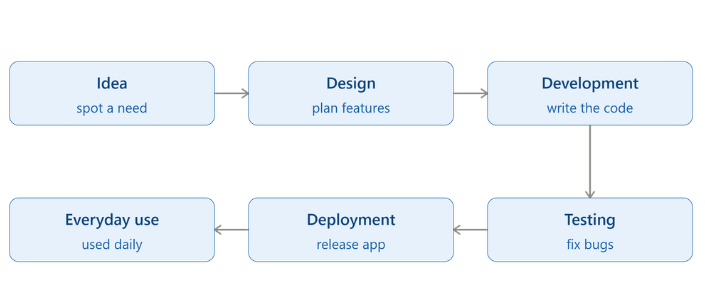
A development team begins with an idea, a challenge, or a problem that needs a practical solution. They determine what users need and decide how the product should work. Designers may create the visual experience, while developers build the underlying system. Testers then look for problems, and the finished product is eventually released.
The work does not necessarily stop after launch. Software often needs updates, security improvements, new features, and repairs.
This is why software development is better understood as an ongoing journey rather than a single event.
Why Does Software Matter in Everyday Life?
You may not think about software when you wake up, but it is probably already involved in your day.
Your alarm may depend on an application. Your phone uses software to manage calls, messages, photographs, and countless other functions. When you check the weather, order food, transfer money, watch a video, or navigate to a new location, software is working behind the scenes.
Businesses also depend heavily on digital systems.
A small shop might use software to manage inventory and payments. A hospital may use digital systems for appointments and records. A bank can use complex platforms to process transactions. Schools use technology for communication, learning, and administration.
The important point is that software is not limited to technology companies. It supports transportation, healthcare, education, finance, entertainment, manufacturing, communication, and many other areas.
As our lives become more connected, the quality and reliability of these systems become increasingly important.
The Main Stages of Creating Software
Although development methods can differ, most projects contain several common stages.
1. Understanding the Problem
Before developers build anything, they need to know what problem they are trying to solve.
Suppose someone wants to create a food-delivery application. The team needs to understand customers, restaurants, delivery workers, payment methods, locations, and possible difficulties.
Simply saying, “We need an app,” is not enough.
The team must ask questions such as:
- Who will use it?
- What problem does it solve?
- What should users be able to do?
- What devices will support it?
- What information needs to be stored?
- What security requirements exist?
Good planning at this stage can prevent expensive mistakes later.
2. Planning
Once the requirements are understood, the team creates a plan.
They decide which features should be developed first, how long different tasks might take, what technologies could be used, and who will be responsible for different parts of the project.
Large projects are often divided into smaller pieces.
Instead of trying to build an entire platform at once, developers might first create account registration, then search, then payments, and then additional features.
Breaking a large project into manageable tasks makes the work easier to organize.
3. Design
Design is about more than making an application look attractive.
A good digital product should be understandable and comfortable to use.
Designers think about buttons, menus, colors, typography, navigation, accessibility, and how users move from one screen to another.
Imagine entering a store where products are scattered randomly and there are no signs. Even if the store sells excellent products, shopping there would be frustrating.
Software can work the same way. A well-designed interface helps people accomplish their goals without unnecessary confusion.
4. Development
This is where developers turn plans and designs into functioning software.
They use programming languages, development tools, frameworks, databases, and other technologies to create the product.
Different types of software may require different technical approaches.
A mobile application, for example, may be developed specifically for smartphones. A website may need a combination of browser-based technologies and server-side systems. A large business platform may contain databases, security systems, communication services, and many interconnected components.
Developers also work with existing libraries and tools instead of creating everything from scratch.
This allows them to solve common problems more efficiently.
Programming Languages and Development Tools
Programming languages are one of the fundamental building blocks of modern software.
Languages such as Python, JavaScript, Java, C#, C++, Swift, and many others are used for different purposes.
There is no single programming language that is perfect for every project.
Python, for example, is widely used for automation, data-related work, web applications, and artificial intelligence.
JavaScript plays a major role in interactive websites and is also used for server-side applications.
Java and C# are commonly associated with business applications and other large software systems.
C and C++ are often used where performance and control over computer resources are particularly important.
The programming language is only one part of the bigger picture.
Developers also use code editors, testing tools, version-control systems, databases, design platforms, cloud services, and deployment systems.
Modern development is therefore more like assembling a toolbox than relying on one tool.
Different Types of Software Development
Software can be created for many different environments.
Web Development
Web developers create websites and browser-based applications.
A simple website might provide information, while a larger web application could allow users to create accounts, communicate with others, purchase products, manage documents, or perform financial activities.
Mobile Development
Mobile developers create applications for smartphones and tablets.
Some applications are designed specifically for one operating system, while others are built using technologies that allow developers to support multiple platforms.
Mobile software needs to consider screen sizes, battery usage, touch controls, notifications, permissions, and device performance.
Desktop Development
Desktop programs run directly on computers.
Examples include office applications, creative tools, communication software, development environments, and specialized business programs.
These applications may need to work with local files, computer hardware, and operating-system features.
Game Development
Games combine programming with artwork, sound, storytelling, animation, physics, and interactive design.
Developers must consider performance carefully because games often require many calculations to happen quickly while displaying detailed graphics.
Embedded Software
Some software operates inside physical products.
Cars, medical equipment, household appliances, industrial machines, cameras, and other devices can contain embedded systems.
In these situations, software may control physical components rather than simply displaying information on a screen.
How Testing Keeps Software Reliable
What happens when an application looks perfect but crashes every time someone tries to pay?
This is why testing is such an important part of development.
Software testing involves checking a product to find errors, unexpected behavior, security weaknesses, and usability problems.
Testing can happen at different levels.
Developers may test individual pieces of functionality. Testers can examine how different parts work together. A team may also test the complete product from the perspective of an ordinary user.
Performance testing can examine whether an application remains responsive when many people use it simultaneously.
Security testing looks for weaknesses that could expose systems or information.
Usability testing asks a different question: can real people actually understand and use the product comfortably?
No software can realistically be guaranteed to contain zero defects. However, careful testing can significantly reduce problems and help teams discover issues before users encounter them.
Popular Approaches to Software Development
Development teams use different methods to organize their work.
Waterfall
The traditional waterfall approach generally moves through defined stages in sequence. Requirements are established first, followed by design, development, testing, and release.
This can work well when requirements are stable and clearly understood from the beginning.
However, it can become difficult when users change their expectations during development.
Agile
Agile approaches focus on flexibility and frequent progress.
Instead of waiting months before showing a finished product, teams often work in smaller cycles and regularly review their results.
Users and stakeholders can provide feedback, allowing the team to adjust priorities.
DevOps
DevOps brings development and operations practices closer together.
The goal is to make building, testing, releasing, monitoring, and maintaining software more efficient.
Automation plays an important role in many DevOps environments.
These approaches are not simply about using particular tools. They represent different ways of organizing people, processes, communication, and technology.
The Importance of User Experience
A technically impressive application can still fail if people do not enjoy using it.
User experience focuses on how people interact with a product.
Consider a banking application. Users generally want to check balances, transfer money, and review transactions without having to search through confusing menus.
A good experience makes common tasks feel natural.
Accessibility is also important. Software should be designed with different users in mind, including people who may have visual, hearing, mobility, or cognitive difficulties.
Features such as readable text, keyboard support, captions, suitable contrast, and clear navigation can make digital products more accessible.
Good design is ultimately about respecting the user’s time and needs.
Security and Privacy in Modern Software
As software handles more personal and financial information, security has become a central concern.
Applications may process names, addresses, passwords, payment details, photographs, messages, business information, and other sensitive data.
Developers therefore need to consider security from the beginning rather than treating it as something to add at the end.
Common security practices include strong authentication, careful access controls, encryption, secure data storage, regular updates, and vulnerability testing.
Privacy is related but not identical to security.
Security focuses heavily on protecting information from unauthorized access or misuse. Privacy also involves questions about what information is collected, why it is collected, how long it is kept, and who can use it.
Users increasingly expect companies to handle their information responsibly.
A trustworthy software product should therefore consider both technical protection and responsible data practices.
The Role of Artificial Intelligence in Development
Artificial intelligence is changing how software is created and maintained.
Developers can use AI-based tools to help generate code, explain unfamiliar programming concepts, identify possible errors, create tests, summarize documentation, and automate repetitive tasks.
However, AI does not eliminate the need for human developers.
Generated code can contain mistakes, security problems, outdated approaches, or solutions that do not fit a project’s specific requirements.
Human judgment remains important.
Developers need to understand what a system is supposed to accomplish, review generated material, test the result, and make decisions about architecture, security, performance, and user needs.
In many cases, AI is better viewed as an assistant rather than a complete replacement for the development team.
The future may involve people spending less time on repetitive work and more time solving complex problems and designing useful products.
Cloud Computing and Modern Development
Cloud technology has changed how many software products are built and operated.
Instead of purchasing and maintaining every server themselves, organizations can use computing resources provided through cloud platforms.
This can make it easier to increase capacity when demand grows.
Imagine a ticket-selling website expecting normal traffic most of the year but suddenly receiving millions of visitors when tickets for a popular event become available. Cloud infrastructure can provide ways to handle changing workloads.
Cloud services can also support databases, file storage, application hosting, monitoring, backups, and development tools.
However, cloud computing still requires careful planning. Organizations need to consider cost, security, reliability, performance, and regulatory requirements.
The cloud is a tool, not an automatic solution to every problem.
The Future of Software Development
Where is software development heading?
The answer is difficult to predict precisely, but several trends are already shaping the industry.
Artificial intelligence is likely to continue influencing coding, testing, documentation, design, and software maintenance.
Automation will also remain important. Repetitive tasks can increasingly be handled by systems that work automatically.
Cybersecurity will become even more significant as software becomes deeply connected to everyday life.
There is also growing interest in applications that work across multiple devices and environments. A person may begin an activity on a phone, continue it on a computer, and interact with the same service through a vehicle or smart device.
Edge computing, connected devices, robotics, augmented reality, and other technologies may create new development opportunities as well.
Yet one thing is unlikely to change: successful software must solve real problems.
Technology can be impressive, but people ultimately care about whether a product is useful, understandable, dependable, affordable, and safe.
How to Start Learning Software Development
If you have ever thought about learning to build software, you do not need to know everything before starting.
Begin with the basics.
Choose one programming language and learn fundamental concepts such as variables, conditions, loops, functions, data structures, and error handling.
Then build small projects.
You could create a calculator, a simple website, a task list, a personal budget tool, or a basic game.
Small projects are valuable because they turn theory into practical experience.
You will make mistakes. That is normal.
In fact, debugging is one of the most useful learning experiences because it teaches you how to investigate problems rather than simply memorize information.
As your skills improve, learn about databases, application programming interfaces, version control, testing, security, and deployment.
You do not have to become an expert in everything at once.
Learning software development is like learning a musical instrument. You become better through regular practice, experimentation, and gradually tackling more difficult challenges.
Conclusion
Software development is the process that turns ideas and problems into useful digital products. It combines planning, design, programming, testing, security, teamwork, and continuous improvement.
From the phone in your hand to the systems operating hospitals, businesses, vehicles, and online services, software plays an enormous role in modern society.
The field continues to change as artificial intelligence, cloud platforms, automation, connected devices, and other technologies develop. Yet the central purpose remains simple: create technology that helps people accomplish something valuable.
Understanding that process makes it easier to appreciate not only the applications we use every day but also the people and decisions behind them.
Frequently Asked Questions
1. What is software development?
Software development is the process of planning, designing, building, testing, releasing, and maintaining software such as websites, mobile applications, desktop programs, and business systems.
2. Do I need to be good at mathematics to learn software development?
You do not need advanced mathematics for many areas of software development. Logical thinking, problem-solving, patience, and consistent practice are often more important when beginning.
3. Which programming language should a beginner learn first?
There is no single correct choice for everyone. Python is often approachable for beginners because its syntax is relatively readable, while JavaScript can be useful for people interested in websites and web applications.
4. How long does it take to learn software development?
The timeline varies considerably. A beginner can learn basic programming concepts within weeks or months, but becoming highly skilled requires continued practice and experience. Building real projects is one of the most effective ways to progress.
5. Will artificial intelligence replace software developers?
AI can automate and assist with many development tasks, but software projects still require people to understand requirements, make design decisions, review results, address security concerns, and solve problems. AI is changing the role of developers rather than simply eliminating the need for them.