

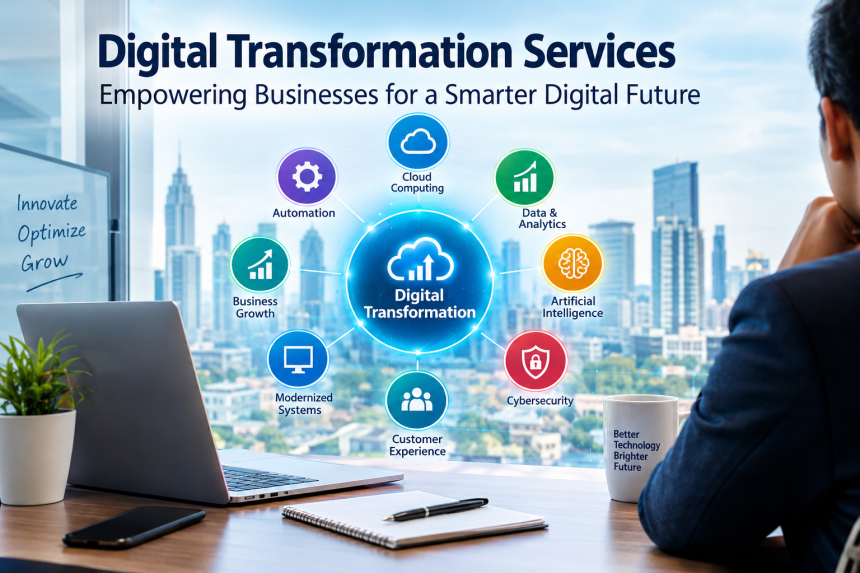
Digital technology has changed the way we work, shop, communicate, learn, and run businesses. Customers expect faster service, convenient online experiences, secure transactions, and quick answers. At the same time, organizations are looking for better ways to manage information, reduce unnecessary costs, and keep up with changing expectations.
This is where digital transformation services come into the picture. They help businesses move beyond outdated processes and use modern technology to create more efficient, flexible, and customer-friendly operations.Digital transformation is about much more than simply purchasing new software; it involves rethinking processes, improving efficiency, and using technology to create meaningful business value. It is about changing the way an organization works so technology supports its goals.
Whether you run a small business, manage a growing company, or simply want to understand how modern organizations are changing, this guide explains the subject in simple terms.
What Is Digital Transformation?
Digital transformation is the process of using modern digital technologies to improve how an organization operates, serves its customers, and achieves its goals. It can range from replacing paper-based tasks with digital solutions to adopting cloud platforms, automation, data analytics, mobile applications, and artificial intelligence to create faster, smarter, and more efficient ways of working.
Think of it like renovating a house. You do not necessarily tear everything down and start again. Instead, you examine what works, identify what needs improvement, and gradually replace outdated parts with better solutions.
For a business, that could mean moving documents to a secure online system, allowing customers to place orders through a website, automating repetitive administrative tasks, or connecting different departments so employees can access the information they need.
The goal is not technology for its own sake. The technology should solve real problems.
A successful digital transformation can help an organization respond more quickly to changing needs, increase productivity, deliver better customer experiences, and make smarter, data-driven decisions.
Why Businesses Are Embracing Digital Change
Customers have become accustomed to convenient digital experiences. People can order food from their phones, transfer money without visiting a bank, book appointments online, and communicate with businesses at almost any time.
Naturally, they often expect similar convenience from other organizations.
Businesses also face increasing competition. A company that still depends entirely on slow manual processes may struggle when another organization can complete the same task in minutes.
There are several reasons organizations begin a digital transformation journey:
- Improved efficiency: Automation can reduce repetitive manual work.
- Better customer service: Digital channels can make communication faster and easier.
- Lower operational costs: Well-designed systems can reduce wasted time and resources.
- Better decision-making: Organized information can help managers understand what is happening.
-
Greater flexibility: Cloud-based tools enable employees to access the information and applications they need from different locations, making remote work and collaboration easier.
- Improved security: Modern platforms can provide stronger controls for protecting information.
- Business growth: Digital systems can make it easier to serve more customers without increasing every expense at the same rate.
However, technology alone is not enough to deliver these benefits; success also depends on effective planning, skilled employees, strong leadership, and thoughtful implementation. Planning, employee training, leadership, and proper implementation are equally important.
The Main Areas of Digital Transformation
Digital transformation can reshape nearly every area of an organization, from daily operations and customer service to communication, decision-making, and long-term business strategy. Some businesses may focus on one area, while others may change several operations at once.
Cloud Technology
Cloud computing allows organizations to store information and use software through internet-based platforms instead of relying entirely on physical computers or local servers.
Cloud technology provides greater flexibility and makes important information easier to access whenever it is needed. Employees working from different locations can stay connected, share files, and collaborate efficiently through a unified digital environment.
Cloud solutions also give businesses the flexibility to scale their resources up or down as their needs change, helping them adapt efficiently to growth, demand, and changing workloads.
Business Process Automation
Many organizations spend significant time on repetitive activities such as entering information, creating reports, sending routine notifications, or moving data between systems.
Automation can handle suitable tasks with limited human involvement.
The important point is to automate intelligently. Not every process should be automated. Tasks requiring judgment, empathy, creativity, or personal interaction may still benefit greatly from human involvement.
Data and Analytics
Modern organizations generate enormous amounts of information. Sales records, customer interactions, website activity, inventory information, and operational data can all reveal useful patterns.
Analytics tools help businesses transform complex data into clear, meaningful insights that support smarter decisions and reveal valuable trends.
For example, a retailer might discover that certain products sell particularly well during specific periods. A service provider could identify common customer complaints and address the underlying issue.
Data becomes truly valuable when it provides clear insights that help people make informed decisions and take meaningful action.
Artificial Intelligence
Artificial intelligence is becoming an increasingly valuable business tool, supporting areas such as customer service, document processing, personalized recommendations, forecasting, content creation, and many other everyday operations.
AI can help organizations handle large amounts of information quickly, but it should be implemented carefully.Businesses should carefully consider factors such as accuracy, data privacy, security, transparency, and human oversight when adopting artificial intelligence.
AI should generally support people rather than encourage organizations to blindly trust automated decisions.
How Digital Transformation Services Work
A digital transformation provider typically begins by understanding how a business currently operates.
This typically involves reviewing existing software, workflows, customer interactions, infrastructure, security measures, and business objectives to identify areas for improvement.
The process often includes several stages.
Assessment: The organization identifies current problems and opportunities.
Planning: Leaders and technology specialists determine what needs to change and establish priorities.
Design: New systems and workflows are carefully designed around the organization’s specific needs, goals, and operational requirements.
Implementation: Technology is introduced, tested, and connected with existing systems where appropriate.
Training: Employees learn how to use new tools and understand revised workflows.
Monitoring: Performance is measured to determine whether the changes are delivering the expected results.
Optimization: Systems are continuously refined and updated over time to meet evolving business needs, improve performance, and deliver better results.
This gradual approach can be more practical than attempting to change everything simultaneously.
Customer Experience in the Digital Age
A business can have excellent internal technology and still disappoint customers if its digital experience is confusing.
Customer experience should therefore remain at the heart of any transformation strategy, ensuring that digital improvements make every interaction more convenient, seamless, and valuable.
Consider a customer trying to contact a company. If they must repeatedly provide the same information to different departments, wait several days for simple answers, or navigate an outdated website, frustration can quickly build.
A well-designed digital experience can make interactions smoother.
Examples include:
- Easy online booking
- Mobile-friendly websites
- Self-service account management
- Online payments
- Personalized recommendations
- Faster customer support
- Order tracking
- Automated notifications
- Consistent communication across channels
The objective is not to remove human contact. Instead, digital tools should make the overall experience more convenient while keeping human assistance available when it is genuinely needed.
Modernizing Legacy Systems
Many established organizations depend on older technology. These systems may still perform important functions, but they can become difficult to maintain, expensive to update, or incompatible with newer applications.
Replacing legacy technology is not always straightforward.
Old systems may contain valuable business information and processes that employees depend on every day. A rushed replacement can create operational problems.
Modernization can therefore take different forms.
An organization might gradually replace individual components, connect older systems with newer platforms, move selected workloads to the cloud, or eventually introduce an entirely new architecture.
The right approach depends on the organization’s budget, risk tolerance, technical environment, and long-term goals.
The Role of Cybersecurity and Data Protection
As businesses become more digital, protecting information becomes increasingly important.
A transformation project should consider cybersecurity from the beginning rather than treating it as an afterthought.
Organizations may need protections such as:
- Strong authentication
- Access controls
- Encryption
- Regular software updates
- Backup systems
- Security monitoring
- Employee awareness training
- Incident response procedures
Data protection is also important because businesses may handle customer names, contact details, financial information, business records, and other sensitive material.
Employees should understand who can access information, why they can access it, and how information should be handled.
Security is not a one-time project. Threats change continuously, so organizations need an ongoing approach.
Employee Adoption and Organizational Culture
One of the most overlooked parts of digital transformation is the human side.
Imagine giving someone a sophisticated new tool without explaining how to use it. The tool may be powerful, but its value will remain limited.
Employees can be concerned about unfamiliar technology, changes to their responsibilities, or the possibility that automation will affect their jobs.
Clear communication can make a major difference.
Organizations should explain why changes are happening, provide practical training, listen to employee feedback, and allow people enough time to adjust.
Digital transformation should ideally help employees spend less time on unnecessary administrative work and more time on activities where human skills matter.
A successful transformation is therefore not simply a technology project. It is also a people project.
Choosing the Right Technology
There is no universal technology package that works for every organization.
A small company may need a simple cloud-based customer management platform and automated accounting tools. A large enterprise may require complex data systems, customized applications, advanced security infrastructure, and integration between numerous departments.
Before purchasing anything, businesses should ask practical questions:
What problem are we trying to solve?
A clear problem usually leads to a clearer technology decision.
Will employees actually use it?
A technically impressive system is not useful if it is too difficult or inconvenient for employees.
Can it work with existing systems?
Compatibility can prevent unnecessary duplication and data problems.
How secure is it?
Security should be evaluated before sensitive information is moved into a new environment.
Can it grow with the organization?
A solution that works today may become restrictive as the business expands.
What is the total cost?
Businesses should consider implementation, training, maintenance, subscriptions, upgrades, and support—not just the initial purchase price.
Taking time to answer these questions can prevent expensive mistakes.
Benefits for Small and Large Businesses
Digital transformation is not exclusively for multinational corporations. Smaller organizations can benefit as well.
A small company might use online scheduling to reduce phone calls, cloud accounting to simplify financial administration, or customer relationship software to organize sales information.
A larger organization may use automation to coordinate thousands of transactions or analytics to understand complex customer behavior.
The scale differs, but the principle remains the same: use technology to make valuable work easier, faster, safer, or more accessible.
For small businesses in particular, digital tools can provide access to capabilities that previously required large teams or expensive infrastructure.
However, smaller organizations should avoid adopting technology simply because it is fashionable. Limited budgets make careful prioritization especially important.
Common Challenges and Mistakes
Digital transformation can produce impressive results, but it is not automatically successful.
One common mistake is focusing on technology before understanding the problem. A company might purchase an expensive platform without changing the inefficient process surrounding it.
Another issue is attempting to transform everything at once. Large projects can become difficult to manage when too many systems and departments are changed simultaneously.
Poor communication can also cause resistance.
Security problems are another concern. Moving quickly without appropriate controls can expose valuable information.
There can also be integration difficulties. A collection of excellent tools may still create frustration if those tools cannot communicate effectively with each other.
Finally, businesses sometimes fail to measure results. Without clear measurements, it becomes difficult to determine whether an investment is actually helping.
The solution is thoughtful planning, realistic goals, testing, employee involvement, and continuous improvement.
How to Build a Practical Transformation Strategy
A successful strategy should begin with business priorities rather than technology trends.
Start by identifying the biggest challenges. Perhaps customers are waiting too long for support, employees spend hours entering information, or managers cannot easily access reliable reports.
Next, determine which problems have the greatest impact.
After that, establish measurable objectives.
For example, instead of saying, “We want better customer service,” a company could aim to reduce average response time or increase the percentage of customer requests resolved during the first interaction.
A practical strategy might follow this structure:
- Identify the problem.
- Understand the current process.
- Set measurable objectives.
- Choose appropriate technology.
- Test the solution on a manageable scale.
- Train employees.
- Measure the results.
- Improve and expand the solution.
This approach creates a feedback loop rather than treating transformation as a one-time event.
What the Future of Digital Business May Look Like
Technology will continue to evolve, and organizations will need to adapt.
Artificial intelligence, automation, cloud platforms, connected devices, advanced analytics, and increasingly personalized digital services are likely to influence many industries.
The most important change, however, may not be a particular technology. It may be the expectation that businesses can adapt quickly.
Customers increasingly expect services to be convenient. Employees expect modern workplaces to provide useful digital tools. Organizations need reliable information to make decisions.
This means transformation is becoming less like a one-time renovation and more like maintaining a growing city. Roads, buildings, communication systems, and services all need to evolve as the population and its needs change.
Businesses that treat digital improvement as an ongoing process can respond more effectively when circumstances change.
Frequently Asked Questions
1. What are digital transformation services?
Digital transformation services help organizations improve their operations by introducing and managing modern digital technologies. They can include cloud computing, automation, software development, data analytics, artificial intelligence, cybersecurity, system integration, and process improvement.
2. Why is digital transformation important for businesses?
It can help businesses improve efficiency, provide better customer experiences, reduce unnecessary manual work, make better use of information, and respond more quickly to changing market conditions. The specific benefits depend on the organization’s goals and how effectively the technology is implemented.
3. Is digital transformation only suitable for large companies?
No. Small and medium-sized businesses can also benefit from digital tools. They may use relatively simple solutions such as cloud software, online payment systems, automated scheduling, customer management platforms, or digital marketing tools.
4. How long does digital transformation take?
There is no universal timeline. A small process improvement might take weeks, while a major organizational transformation can take several years. The duration depends on the organization’s size, existing technology, project complexity, budget, and employee readiness.
5. What is the biggest factor in successful digital transformation?
Technology is important, but successful transformation also requires clear goals, employee participation, strong leadership, effective training, security, and continuous measurement. Organizations generally achieve more when they focus on solving specific business problems instead of adopting technology simply because it is new.
Conclusion
Digital transformation is ultimately about improving how organizations work and how people experience their services. Technology provides the tools, but successful transformation depends on thoughtful planning, capable people, strong security, and a clear understanding of customer needs.
From cloud computing and automation to analytics and artificial intelligence, modern solutions can help businesses become more efficient and adaptable. Yet the best results usually come from solving real problems rather than chasing every new technology trend.
For organizations considering their next step, the most useful question may be simple: What could we make easier, faster, safer, or more useful for the people we serve? Starting there can turn digital change from an expensive technology project into meaningful business improvement.