

Technology continues to change the way we live, work, communicate, and manage information. One of the most talked-about developments in the digital world is blockchain technology. Although many people first heard about it through cryptocurrencies such as Bitcoin, its potential reaches far beyond digital money.
Today, this system is being explored for finance, healthcare, supply chains, education, cybersecurity, digital identity, and many other areas. But what exactly is it, and why has it attracted so much attention? Is it simply another technology trend, or could it change the way people and organizations share information?
In simple terms, blockchain is a way of recording and sharing data across a network in a secure and transparent manner. Instead of keeping information in one central location, copies of the data can be distributed across multiple computers. This creates a system where records are difficult to alter without agreement from the network.
This article explains how blockchain works, where it is used, its benefits and limitations, and what the future may look like. Whether you are completely new to the topic or simply want a clearer understanding, this guide will help you explore the subject without unnecessary technical complexity.
What Is Blockchain Technology?
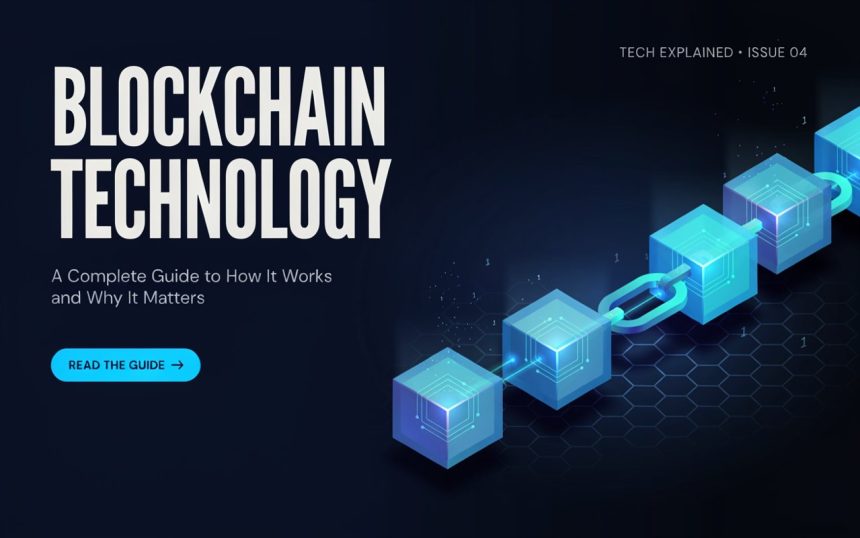
At its most basic level, blockchain is a digital record system that stores information in connected groups called blocks. Each block contains data, and the blocks are linked together in a sequence, creating a chain.
That is where the name comes from: block + chain.
Imagine a shared notebook used by hundreds or thousands of people. Every time someone adds a new entry, everyone involved can verify that the entry follows the rules. Once the information is confirmed and recorded, changing it becomes extremely difficult.
This is similar to how a blockchain network works.
Instead of one company or institution controlling the entire record, information can be maintained across many computers. These computers, often called nodes, work together to store and verify data.
A simple analogy: Think of blockchain as a train made up of connected carriages. Each carriage represents a block of information. Once a carriage is attached to the train and the journey continues, removing or secretly changing it becomes much harder because the rest of the train is connected to it.
This structure can make the system useful in situations where trust, transparency, and accurate records are important.
How Does a Blockchain Work?
Understanding how this technology works may sound complicated at first, but the basic process can be explained step by step.
When someone wants to add new information to the network, a transaction or data request is created. Depending on the type of blockchain, this could involve sending digital currency, recording a product shipment, or storing another form of verified information.
The network then checks whether the information follows its established rules.
Step 1: A Transaction or Record Is Created
A user begins an activity that needs to be recorded. For example, imagine someone sending digital currency to another person.
The transaction includes important details, such as who is sending it, who is receiving it, and how much is being transferred.
Step 2: The Network Verifies the Information
The request is shared with computers connected to the network. These participants help verify whether the transaction is valid.
Different blockchain systems use different methods to reach agreement. This process is often called consensus.
The purpose is simple: the network needs a way to agree on which information is accurate before adding it permanently.
Step 3: The Information Is Added to a Block
Once verified, the transaction becomes part of a new block.
A block can contain multiple records or transactions. It also contains information that connects it to the previous block.
Step 4: The Block Joins the Chain
The verified block is added to the existing sequence of blocks.
Because each block is connected to earlier records, changing past information can become extremely difficult. Altering one block could affect the links connected to other blocks.
Step 5: The Record Becomes Part of the Shared History
The updated information is distributed across the network.
This creates a shared record that participants can use for verification. Depending on the blockchain design, the information may be publicly visible or accessible only to authorized participants.
The entire process is designed to reduce the need for a single central authority to control every record.
Why Is Decentralization Important?
Traditional digital systems are usually centralized.
For example, a bank may store customer information on its own servers. A social media company controls the information stored on its platform. A government department maintains official records through its own systems.
In a centralized system, one organization or authority generally has significant control over the database.
Blockchain introduces a different approach called decentralization.
Instead of relying entirely on one central database, information can be shared across a network of computers.
This does not mean that every blockchain operates without leadership or rules. Many systems still have administrators, developers, organizations, or governing structures. However, the way records are stored and verified can be distributed among multiple participants.
Why does this matter?
A decentralized structure can reduce dependence on a single point of failure. If one computer or server experiences a problem, other parts of the network may continue operating.
It can also improve transparency because participants may have access to the same version of important records.
However, decentralization is not automatically better in every situation. Some organizations may prefer centralized systems because they are faster, easier to manage, or more suitable for private information.
The value of blockchain depends on the problem being solved.
Blockchain and Cryptocurrency
For many people, the first connection they make with blockchain is cryptocurrency.
Bitcoin introduced a popular example of how a distributed digital ledger could be used to support a form of electronic money without relying entirely on a traditional central bank.
In a cryptocurrency network, blockchain can record transactions between users.
For example, if Person A sends digital currency to Person B, the transaction can be verified and added to the network’s record.
The blockchain helps prevent problems such as double spending, where someone might attempt to spend the same digital asset more than once.
Digital Currency Is Only One Use
Although cryptocurrency made blockchain famous, the technology itself can be used for many other purposes.
A blockchain is essentially a system for recording and verifying information. The type of information can vary.
For example, it may be used to track:
- Financial transactions
- Product movement
- Digital ownership
- Contracts
- Medical information
- Educational certificates
- Identity records
This is why many people believe blockchain has applications beyond the world of cryptocurrency.
The Role of Transparency and Trust
Trust is one of the most important ideas connected with blockchain.
In many traditional systems, people must trust an organization to manage information correctly.
For example, when you use a bank, you trust the bank to maintain accurate records of your money. When you buy something online, you trust the company to process your payment correctly.
Blockchain attempts to create trust through technology and shared verification.
Instead of asking people to trust one central organization completely, the system can allow multiple participants to confirm information.
Shared Records
When authorized participants have access to the same record, it can become easier to identify inconsistencies.
Imagine a group project where every member has a copy of the same document. If one person secretly changes something, the difference may become noticeable because others have matching copies.
A blockchain works on a much more advanced level, using cryptographic techniques and network rules, but the basic idea of shared verification is similar.
Transparency Does Not Always Mean Public Access
A common misunderstanding is that blockchain automatically makes all information public.
This is not always true.
Some networks are public, meaning many people can view the available records. Others are private or permissioned, meaning access is limited to approved participants.
For example, a healthcare organization would not want sensitive patient information openly available to everyone.
Therefore, blockchain systems can be designed with different levels of visibility and access.
Major Types of Blockchain Networks
Not every blockchain works in the same way. Different networks are designed for different purposes.
Understanding the main categories can make the subject easier to follow.
Public Blockchain
A public blockchain is generally open to anyone who wants to participate.
Users may be able to view transactions, join the network, and sometimes help validate information.
Bitcoin is one of the best-known examples of a public blockchain.
Public networks often focus on openness and decentralization.
Private Blockchain
A private blockchain is controlled by a specific organization or group.
Access is usually restricted to approved participants.
Businesses may use private networks when they want the benefits of shared records while maintaining greater control over who can access the system.
Consortium Blockchain
A consortium blockchain is managed by several organizations rather than one individual organization.
For example, multiple companies in the same industry might work together to operate a shared network.
This approach can be useful when several trusted organizations need access to the same information.
Hybrid Blockchain
A hybrid system combines elements of public and private networks.
Some information may remain private while other parts are available for public verification.
The best type depends on the needs of the people or organizations using the technology.
Real-World Uses Beyond Cryptocurrency
One of the most interesting aspects of blockchain is its potential use in different industries.
While not every proposed application will succeed, several areas are actively exploring how distributed ledgers can improve existing systems.
Supply Chain Management
Supply chains involve many different participants.
A product may move from a manufacturer to a warehouse, distributor, retailer, and finally to the customer.
Tracking every stage can be difficult.
Blockchain can potentially create a shared history of a product’s journey.
For example, information could record where a product was produced, when it was shipped, and when it arrived at a specific location.
This could help businesses improve traceability and make it easier to identify problems.
Consumers may also benefit from greater visibility into the products they buy.
Healthcare
Healthcare systems manage large amounts of important information.
Medical records need to be accurate, secure, and accessible to authorized professionals.
Blockchain could potentially support better record management by creating verifiable information systems.
However, privacy remains extremely important.
Healthcare applications would need strong security and carefully controlled access. The technology cannot simply make sensitive information available to everyone.
Digital Identity
People often use multiple usernames, passwords, identification documents, and online accounts.
Managing digital identity can be frustrating.
Blockchain-based identity systems are being explored as a way to give individuals more control over certain digital credentials.
For example, a person might be able to prove that they meet a requirement without sharing unnecessary personal information.
The idea is still developing, but digital identity could become an important area for future applications.
Education
Educational institutions issue certificates, degrees, and other records.
Unfortunately, verifying documents can sometimes be time-consuming.
A blockchain-based system could allow educational achievements to be recorded in a verifiable way.
Employers or institutions could potentially confirm whether a certificate is genuine more easily.
Real Estate
Property transactions often involve large amounts of paperwork.
Blockchain technology could help record ownership information and transaction history.
Smart systems may also simplify certain administrative processes.
However, real estate laws differ between countries, so widespread adoption would require cooperation with legal and government systems.
What Are Smart Contracts?
Smart contracts are another important concept connected with blockchain.
Despite the name, a smart contract is not simply a traditional legal document.
It is a computer program designed to automatically perform certain actions when specific conditions are met.
For example, imagine a simple agreement:
If a customer makes a payment, access to a digital product is automatically provided.
A smart contract can be programmed to carry out this process according to predefined rules.
Automation and Efficiency
Smart contracts can reduce the need for manual steps in some situations.
For example, businesses may use automated agreements for payments, approvals, or other processes.
However, they are not perfect.
A smart contract follows the instructions written into its code. If the code contains mistakes or unclear logic, problems can occur.
That is why testing, security reviews, and careful development are important.
Smart contracts are powerful tools, but they should not be viewed as magical solutions to every agreement or business problem.
Security and the Role of Cryptography
Security is one of the biggest reasons people are interested in blockchain.
The technology often uses cryptography, which involves mathematical methods for protecting information.
Each block can contain a unique digital identifier related to its contents.
If someone attempts to change information in a previous block, the digital connection between records may no longer match.
This makes unauthorized changes easier to detect.
Why Changing Records Is Difficult
Imagine a long chain of locked boxes.
Each box contains information about the previous one.
If someone secretly changes the contents of an earlier box, they would need to update many connected boxes while also convincing the rest of the network to accept those changes.
That can be extremely difficult, especially in large and well-designed networks.
However, it is important to understand something clearly:
Blockchain is not automatically unbreakable.
Security depends on many factors, including:
- Network design
- Software quality
- User behavior
- Cryptographic systems
- Network size
- Access controls
People can still lose passwords, fall for scams, or use insecure platforms.
Technology can strengthen security, but human mistakes remain a major risk.
Advantages of Blockchain Technology
Blockchain offers several potential benefits, depending on how and where it is used.
Improved Transparency
Shared records can make certain transactions easier to verify.
Participants may have access to the same information, reducing confusion caused by separate databases.
Greater Traceability
The history of a product, transaction, or digital asset can potentially be tracked over time.
This can be useful in supply chains, financial systems, and record management.
Reduced Dependence on Intermediaries
Some blockchain applications can reduce the need for third parties to verify transactions.
This may save time or reduce costs in certain situations.
However, intermediaries are not always unnecessary. Many provide valuable services, legal protection, and expertise.
Stronger Record Integrity
Once information is properly recorded and confirmed, altering it can become difficult.
This may improve confidence in important records.
Automation
Smart contracts can automate certain actions when specific conditions are met.
This could improve efficiency in business processes.
Global Accessibility
Digital networks can connect people and organizations across different locations.
Blockchain-based systems may allow users to exchange information or assets without traditional geographical limitations.
Of course, local laws and regulations still apply.
Challenges and Limitations
Despite its potential, blockchain is not a perfect solution.
Like every technology, it has weaknesses and limitations.
Understanding these challenges is just as important as understanding the benefits.
Energy Consumption
Some blockchain systems use significant amounts of energy.
This is particularly associated with certain consensus methods.
As technology develops, many projects are exploring more energy-efficient approaches.
Environmental impact remains an important topic when evaluating digital networks.
Speed and Scalability
Large networks can sometimes process transactions more slowly than traditional systems.
If millions of people use a network at the same time, the system must be able to handle large amounts of activity.
Developers continue working on solutions that improve speed and scalability.
Complexity
For the average person, blockchain can feel confusing.
Terms such as wallets, private keys, consensus, and tokens may discourage newcomers.
Widespread adoption will likely depend on creating simpler and more user-friendly experiences.
After all, most people do not want to understand complicated technical systems just to complete a basic task.
Regulation
Governments around the world are still developing rules related to digital assets and blockchain applications.
Different countries may take different approaches.
Clear regulations could encourage responsible innovation, but overly complicated rules might slow development.
Finding the right balance will be an ongoing challenge.
Security Risks
Although the technology itself may provide strong protection, related systems can still be vulnerable.
For example:
- A user may lose access credentials.
- A platform may experience a security breach.
- A smart contract may contain coding errors.
- Criminals may create scams.
Users should always remain cautious and learn how digital systems work before trusting money or personal information to them.
Blockchain in Business and Everyday Life
Will ordinary people use blockchain directly in the future?
The answer may be yes, but many people may not even realize they are using it.
Think about how the internet works today.
Most people use websites, messaging applications, and online services without understanding how internet protocols operate.
The same could happen with blockchain.
A person might use a digital identity service, track the origin of a product, receive a verified certificate, or make a secure payment without thinking about the underlying technology.
Business Adoption
Companies may use blockchain where multiple organizations need access to reliable shared information.
For example, a logistics company, manufacturer, and retailer may benefit from having a common record of product movement.
Banks and financial institutions may also explore distributed systems for payments and settlement.
However, businesses will only adopt the technology when it provides a clear advantage.
Using blockchain simply because it is popular does not guarantee success.
The best technology is the one that solves a real problem efficiently.
The Connection Between Blockchain and Web3
Blockchain is often discussed alongside the idea of Web3.
Web3 is a broad term used to describe a possible future version of the internet that places greater emphasis on decentralized systems, digital ownership, and user participation.
In traditional online platforms, companies usually control the services and data.
Web3 projects explore systems where users may have greater control over digital assets and identities.
Blockchain can provide the infrastructure for some of these systems.
For example, digital assets may be recorded on distributed networks, allowing ownership information to be verified.
However, Web3 is still an evolving concept.
Some people see it as a major step toward a more decentralized internet, while others believe many challenges must be solved before it can become widely useful.
The future will likely include a combination of centralized and decentralized technologies.
The Future of Blockchain Technology
Predicting the future of technology is never easy.
Some ideas that seem revolutionary disappear quickly, while others become part of everyday life.
Blockchain may continue to develop in several important areas.
Better Integration
Future systems may connect blockchain with other technologies such as:
- Artificial intelligence
- Internet of Things devices
- Cloud computing
- Digital identity systems
- Automation platforms
For example, connected devices could record verified information automatically, while AI systems could analyze that information.
More User-Friendly Platforms
For blockchain to reach a wider audience, services will need to become easier to use.
People should not need advanced technical knowledge to protect their digital assets or access useful services.
Better interfaces and stronger security tools could make the technology more practical for everyday users.
Government and Public Services
Some governments and institutions are exploring distributed ledger systems for record management and digital services.
Possible applications include identity systems, certificates, public records, and document verification.
However, privacy and security will remain essential.
Financial Innovation
Financial services are likely to remain one of the most important areas for blockchain development.
Digital payments, asset tokenization, international transfers, and automated financial agreements may continue to evolve.
At the same time, regulations and consumer protection will play an important role.
Should You Care About Blockchain?
You do not need to become a programmer or cryptocurrency investor to understand why blockchain matters.
Like artificial intelligence, cloud computing, and the internet, blockchain is part of a larger shift in how digital information can be managed.
The most important question is not whether blockchain will replace every existing system.
It probably will not.
A better question is: Where can distributed, verifiable records provide real value?
In some situations, traditional databases will remain faster and more practical.
In others, blockchain may improve transparency, security, or cooperation between different organizations.
The technology should be viewed as a tool.
A hammer is useful for driving nails, but you would not use it to solve every problem in your house. In the same way, blockchain is powerful when used for the right purpose.
Understanding its strengths and limitations allows people to separate genuine innovation from unnecessary hype.
Conclusion
Blockchain technology represents a different way of recording, sharing, and verifying digital information. Its most important feature is not simply cryptocurrency. Instead, its broader value comes from the possibility of creating shared, secure, and verifiable records across networks.
From finance and supply chains to healthcare, education, identity, and digital ownership, the potential applications are wide. At the same time, challenges involving scalability, energy use, regulation, security, and user experience cannot be ignored.
The future of blockchain will depend on practical solutions rather than promises. The technology does not need to replace every traditional system to make a meaningful impact. If it can solve specific problems more effectively, securely, or transparently, it may become an important part of the digital world.
For the general public, the best approach is to stay curious. Learn the basics, question exaggerated claims, and understand both the opportunities and the risks. Blockchain may still be evolving, but its influence on technology and digital innovation is already worth watching.
Frequently Asked Questions
1. What is blockchain technology used for?
Blockchain technology can be used for recording and verifying information. Common applications include cryptocurrency, supply chain tracking, digital identity, smart contracts, financial services, healthcare records, and document verification.
2. Is blockchain the same as Bitcoin?
No. Bitcoin uses blockchain technology, but blockchain itself is a broader concept. The technology can support many different applications beyond digital currency.
3. Is blockchain secure?
Blockchain can provide strong security through cryptography and distributed verification. However, no system is completely risk-free. Security also depends on software quality, network design, and user behavior.
4. Can blockchain be used without cryptocurrency?
Yes. Many organizations explore blockchain for purposes that have nothing to do with cryptocurrency, including supply chains, healthcare, education, identity, and business record management.
5. What is the future of blockchain technology?
Blockchain may continue to grow through improved scalability, better security, easier user experiences, and integration with technologies such as artificial intelligence and connected devices. Its long-term success will depend on whether it solves real-world problems effectively.