

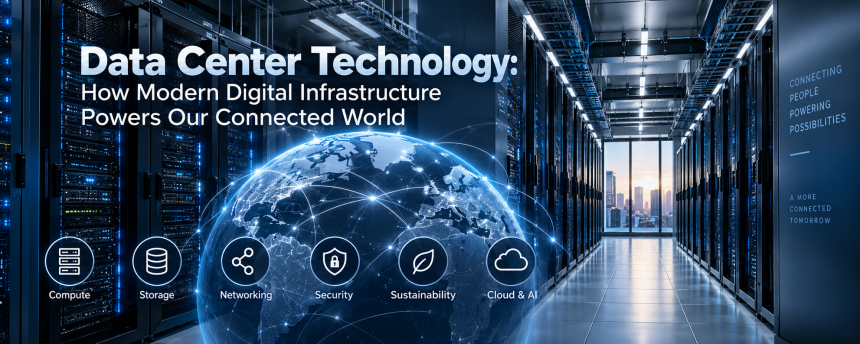
Have you ever wondered what happens behind the scenes when you stream a movie, send a message, upload a photo, use online banking, or ask an AI assistant a question? Much of that activity depends on enormous facilities filled with computers, storage systems, networking equipment, cooling infrastructure, and power systems.
These facilities are commonly known as data centers. They form the backbone of the modern digital economy, quietly processing and storing huge amounts of information every second. As cloud services, artificial intelligence, online applications, connected devices, and digital businesses continue to grow, the technology inside these facilities is changing rapidly.
Modern infrastructure is no longer simply a room filled with servers. It has become a highly engineered environment designed for speed, reliability, efficiency, security, and continuous operation. In many ways, a data center is like the electrical grid of the internet: users may rarely see it, but countless digital services depend on it.
This article explores how modern infrastructure works, the major technologies involved, emerging innovations, challenges, and what the future may look like.
What Is a Data Center?
A data center is a specialized facility where computing systems and supporting equipment are installed to process, store, and transfer digital information.
At its simplest level, the concept sounds straightforward. Computers need somewhere to operate, data needs somewhere to live, and networks need reliable connections. But operating thousands or even hundreds of thousands of machines simultaneously is far more complicated than running a personal computer at home.
A modern facility may contain:
- Servers for processing applications and workloads
- Storage systems for keeping digital information
- Network equipment for moving data
- Power systems for maintaining continuous operation
- Cooling equipment for controlling temperature
- Security systems for protecting physical and digital assets
- Monitoring platforms for identifying problems
- Backup systems for maintaining availability during failures
These components work together as one large ecosystem.
Businesses can build facilities for their own operations, while cloud providers operate massive facilities that support services for thousands or millions of customers.
The key objective is simple: keep computing resources available when people and businesses need them.
How Modern Data Centers Work
Understanding how these environments operate becomes easier if you think of one as a highly organized city.
Servers are similar to buildings where different activities take place. Networks act like roads connecting those buildings. Electricity is the city’s energy supply, while cooling systems remove the heat produced by all the activity.
When you open a website, for example, your request travels through a network to computing infrastructure. A server processes the request, retrieves information from storage or another service, and sends the response back.
This process can happen in fractions of a second.
Servers
Servers are specialized computers designed to operate continuously. Unlike ordinary desktop computers, they are generally built for reliability, remote management, and heavy workloads.
Different servers can perform different jobs. Some may host websites, others may run databases, while others handle artificial intelligence, analytics, video processing, or virtual machines.
Storage
Storage systems preserve information even when an application is not actively using it. Modern environments can use solid-state drives, hard drives, distributed storage platforms, and specialized systems designed for enormous datasets.
Networking
Networking equipment connects servers with one another and connects facilities to external networks. High-speed switches, routers, optical connections, and other infrastructure allow enormous quantities of information to move between systems.
The result is a carefully coordinated environment where computing, storage, networking, power, and cooling operate together.
The Role of Cloud Computing
Cloud computing has transformed the way organizations use digital infrastructure.
In the past, a company might purchase physical servers, install them in its own facility, and maintain them internally. Today, organizations can rent computing resources from cloud providers instead.
This approach provides flexibility.
A small company might need only a handful of virtual machines today but require significantly more computing power during a major product launch. Cloud platforms allow organizations to increase or reduce resources according to demand.
Virtualization
Virtualization allows one physical server to support multiple virtual computing environments. Instead of dedicating an entire machine to a single application, available resources can be divided among several workloads.
This can improve utilization and reduce wasted capacity.
Containers
Containers provide another approach to application deployment. They package software and its dependencies into portable environments, making it easier for developers to move applications between systems.
Distributed Computing
Cloud platforms also distribute workloads across multiple machines and locations. If one system experiences a problem, another system may continue serving users.
This architecture helps improve resilience while allowing large services to operate at global scale.
Artificial Intelligence Is Changing Infrastructure
Artificial intelligence has become one of the biggest forces influencing modern computing facilities.
Traditional applications often rely heavily on general-purpose processors. Many AI workloads, however, benefit from specialized accelerators capable of performing large numbers of mathematical operations simultaneously.
This creates new infrastructure requirements.
AI systems can require:
- High-performance processors
- Specialized accelerators
- Extremely fast networking
- Large amounts of memory
- High-speed storage
- Advanced cooling
- Substantial electrical capacity
Training a large AI model may involve thousands of processors working together for extended periods.
Why Does AI Require So Much Infrastructure?
AI models process enormous datasets and perform huge numbers of calculations. The more sophisticated the model becomes, the greater the computing resources required.
This creates an interesting challenge. Organizations want more powerful AI systems, but greater computing power also means greater energy consumption and heat generation.
As a result, AI is encouraging engineers to rethink everything from rack design to cooling technology and electrical distribution.
Cooling Technology and Energy Efficiency
Computers produce heat whenever they operate. In a large facility, that heat can become a serious engineering problem.
Traditional environments commonly use air-based cooling. Fans and air-conditioning systems move cool air toward equipment while carrying hot air away.
However, increasingly powerful processors are producing higher heat densities, making traditional approaches less effective in some applications.
Liquid Cooling
Liquid cooling is becoming increasingly important for high-performance workloads.
Instead of depending entirely on air, liquid can transfer heat away from processors much more efficiently.
There are different approaches, including direct-to-chip cooling and immersion-based systems.
In direct-to-chip systems, cooling liquid is brought close to heat-producing components. Immersion systems place certain hardware components into specially designed non-conductive liquids.
These approaches can support high-density computing while potentially reducing the amount of mechanical cooling required.
Energy Efficiency
Efficiency is not simply an environmental concern. It is also an economic issue.
Electricity can represent a major operating expense. Therefore, operators continually look for ways to use less energy while maintaining performance.
Better processors, efficient power systems, intelligent cooling, workload optimization, and renewable energy can all contribute to more efficient operations.
Networking: The Highway of Digital Infrastructure
Imagine a city filled with thousands of buildings but almost no roads. The buildings might be powerful, but they would not be very useful.
The same principle applies to computing facilities.
Networking provides the connections that allow servers, storage systems, users, and external services to communicate.
Modern workloads increasingly require extremely high-speed connections because applications are moving larger amounts of information between machines.
High-Speed Switching
Switches connect multiple systems and direct information toward the appropriate destination.
Optical Networking
Fiber-optic connections can transport enormous quantities of data over long distances with low latency. This makes them essential for connecting facilities and major network locations.
Low-Latency Infrastructure
For applications such as financial systems, interactive gaming, real-time analytics, and AI workloads, delays matter.
Reducing the distance data travels and improving network performance can make applications feel faster and more responsive.
This is one reason companies increasingly deploy computing resources closer to users.
Edge Computing Brings Processing Closer to Users
Traditional cloud infrastructure often relies on large centralized facilities. Edge computing takes some processing closer to where data is created or consumed.
Why does this matter?
Consider an autonomous vehicle. It cannot always wait for information to travel to a distant facility and return before making a decision. Similarly, industrial equipment may need immediate responses.
Edge computing can reduce latency by processing information locally or in nearby infrastructure.
Potential applications include:
- Smart cities
- Connected vehicles
- Industrial automation
- Healthcare technology
- Retail systems
- Video analytics
- Internet-connected devices
- Augmented and virtual reality
Edge infrastructure does not necessarily replace large centralized facilities. Instead, the two approaches can complement each other.
Central locations can handle large-scale processing and storage, while edge locations can respond quickly to local requirements.
Security and Reliability
A modern computing facility must be designed around failure because failures are inevitable.
Power interruptions, hardware failures, network problems, software errors, natural disasters, and human mistakes can all affect operations.
The goal is therefore not to create a system that can never fail. The goal is to build systems that can continue operating when individual components fail.
Redundant Power
Facilities may use multiple power sources, backup generators, batteries, and uninterruptible power systems.
Redundant Networking
Multiple network paths can prevent one broken connection from taking an entire service offline.
Backup Storage
Important information may be copied across multiple systems or geographic locations.
Physical Security
Access controls, cameras, security personnel, authentication systems, and carefully controlled entry procedures help protect equipment.
Cybersecurity
Digital defenses are equally important. Firewalls, identity controls, encryption, monitoring systems, vulnerability management, and security operations help protect data and applications.
Reliability is therefore a combination of hardware, software, people, procedures, and planning.
Automation and Intelligent Management
Managing thousands of physical machines manually would be extremely difficult.
Automation allows operators to monitor infrastructure, deploy workloads, identify problems, adjust resources, and perform routine tasks more efficiently.
Modern management platforms can collect information about:
- Temperature
- Power consumption
- Hardware health
- Network performance
- Storage capacity
- Processor utilization
- Application performance
Machine learning can also help identify unusual patterns.
For example, if a server begins behaving differently from similar machines, monitoring software may flag the problem before a complete failure occurs.
Predictive Maintenance
Instead of waiting for equipment to break, operators can analyze performance information to identify signs of potential failure.
This approach can reduce downtime and help organizations schedule maintenance before a serious incident occurs.
Automation is increasingly becoming the control system that coordinates complex infrastructure.
Sustainability and the Future of Energy
The rapid expansion of digital services raises an important question: How can the world support increasing computing demand without creating unnecessary environmental costs?
Operators are exploring several approaches.
Renewable electricity can reduce dependence on fossil-fuel-based power generation. More efficient processors can reduce energy consumption for individual workloads. Advanced cooling can lower the energy required to manage heat.
Some facilities are also exploring ways to reuse waste heat.
For example, heat generated by computing equipment may potentially be redirected toward district heating systems or other applications where local conditions make this practical.
Water usage is another consideration. Certain cooling approaches consume significant amounts of water, so facility designers increasingly evaluate water efficiency alongside electricity consumption.
Sustainability is becoming a broader engineering objective rather than a separate project.
Modular and Hyperscale Infrastructure
Not every organization needs the same type of facility.
Some businesses operate relatively small installations, while major technology companies may build enormous campuses capable of supporting large-scale cloud and AI workloads.
Hyperscale Facilities
Hyperscale infrastructure is designed to expand massively. Standardized equipment, automated deployment, high-capacity networking, and carefully engineered power systems allow operators to add computing capacity rapidly.
Modular Infrastructure
Modular designs can provide another option.
Instead of constructing one enormous facility all at once, organizations can deploy standardized modules and expand them as demand grows.
This approach can potentially reduce construction time and make capacity planning more flexible.
The shift toward modular systems reflects a simple business reality: digital demand can change faster than traditional construction projects.
Data Center Technology Trends to Watch
The next several years are likely to bring significant changes.
AI-Optimized Infrastructure
As AI workloads continue growing, facilities will increasingly be designed around accelerated computing, high-bandwidth networking, and advanced thermal management.
More Liquid Cooling
Higher processor power density is likely to accelerate adoption of liquid-based thermal solutions.
Greater Automation
Software will play a larger role in infrastructure management, maintenance, capacity planning, and energy optimization.
Distributed Infrastructure
More processing is likely to move toward regional and edge locations where low latency is important.
Energy-Aware Computing
Operators may increasingly consider the availability, cost, and carbon impact of electricity when deciding where and when workloads should run.
Improved Hardware Efficiency
Processor manufacturers will continue looking for ways to deliver greater performance without increasing energy consumption at the same rate.
Stronger Security
As more valuable information moves through digital infrastructure, physical and cybersecurity defenses will continue evolving.
These trends are connected. Better AI hardware creates new cooling requirements. More computing creates greater power demand. Greater power demand increases the importance of efficiency. More distributed infrastructure increases management and security challenges.
One development can influence the entire ecosystem.
Why Data Centers Matter to Everyday People
It is easy to think of these facilities as something relevant only to large technology companies. In reality, their influence reaches ordinary daily life.
When you:
- Watch a streaming service
- Store photographs online
- Use a navigation application
- Make an online purchase
- Send an email
- Use social media
- Back up your smartphone
- Access online banking
- Play an online game
- Use an AI application
you are likely depending on remote computing infrastructure somewhere along the way.
Businesses depend on it too.
Hospitals use digital systems for records and applications. Banks process transactions through complex computing environments. Manufacturers use connected systems to monitor equipment. Schools rely on cloud platforms for communication and learning.
The digital world may feel invisible, but it rests on physical foundations.
Behind every virtual service are real buildings, cables, processors, electrical systems, cooling equipment, and people maintaining them.
Challenges Facing the Industry
Despite rapid innovation, several major challenges remain.
Rising Energy Demand
AI and other intensive workloads can significantly increase electricity requirements.
Grid Capacity
Building new facilities is not only about constructing walls and installing servers. Local electricity infrastructure must be capable of supporting the required load.
Hardware Supply
Advanced processors, networking equipment, and other components can face manufacturing and supply constraints.
Construction Time
Large facilities can take years to plan and construct.
Water Management
Cooling requirements can create pressure on local water resources in some regions.
Cybersecurity Threats
The value of the information and computing resources inside these environments makes them attractive targets.
Skills Shortages
Operating advanced infrastructure requires engineers, technicians, security specialists, electricians, networking professionals, and many other skilled workers.
Solving these challenges will require cooperation among technology companies, utilities, governments, engineers, and local communities.
What Does the Future Look Like?
The future of digital infrastructure will probably be defined by one central idea: more computing with greater efficiency.
Demand for digital services is unlikely to disappear. If anything, AI, connected devices, immersive applications, automation, and cloud platforms are likely to increase the amount of computing required.
But simply adding more machines is not enough.
Future facilities will need to become smarter.
They will need to understand their own energy consumption, automatically adjust workloads, optimize cooling, predict equipment failures, and make better use of available resources.
At the same time, computing will become more geographically distributed. Some tasks will run in massive centralized facilities, while others will be processed closer to users.
Think of the future as a network of interconnected computing hubs rather than a handful of isolated buildings.
The most successful operators will likely be those that can balance performance, reliability, security, cost, and sustainability.
Conclusion
Data center technology is one of the foundations of modern digital life. Although most people never see these facilities, they support services that millions of people use every day.
The industry is moving beyond traditional server rooms toward highly automated, energy-conscious, AI-ready infrastructure. Advanced networking, accelerated computing, liquid cooling, edge processing, virtualization, automation, and stronger security are all changing how digital services are delivered.
The biggest challenge will be managing growing demand responsibly. Computing power will continue to increase, but so will expectations around efficiency, reliability, environmental impact, and security.
Ultimately, the future is not simply about building bigger facilities. It is about building smarter infrastructure that can support a rapidly connected world without wasting resources.
Frequently Asked Questions
1. What is the main purpose of a data center?
Its primary purpose is to provide a secure and reliable environment for computing, storing, and transferring digital information. It supports applications, websites, cloud services, databases, AI workloads, and many other digital systems.
2. Why do data centers need so much cooling?
Electronic equipment generates heat while operating. If that heat is not removed effectively, hardware can become less reliable or fail. Cooling systems maintain suitable operating conditions and protect equipment.
3. How is AI changing data center infrastructure?
AI workloads often require powerful accelerators, large memory capacity, fast networking, and advanced cooling. As these workloads grow, facilities are being redesigned to support higher computing density and greater power requirements.
4. What is the difference between cloud computing and a data center?
A data center is the physical infrastructure containing computing, storage, networking, power, and cooling systems. Cloud computing is a service model that allows users to access computing resources over a network without owning all of the underlying physical infrastructure.
5. Will data centers become more energy efficient?
Efficiency is a major focus across the industry. Improvements in processors, cooling, power management, workload scheduling, renewable energy, and facility design can help reduce the resources required to deliver computing services.