
Technology rarely changes the world all at once. Instead, small breakthroughs begin to appear, improve over time, and eventually become part of everyday life. A few years ago, video calls, smart assistants, electric vehicles, and AI-powered tools seemed futuristic to many people. Today, they are increasingly normal.
Now, another wave of innovation is gathering momentum. Artificial intelligence is becoming more capable, robots are learning to work alongside humans, medical science is becoming increasingly personalized, and new computing systems are attempting to solve problems that traditional machines struggle to handle. At the same time, cleaner energy, immersive digital experiences, and connected devices are changing how people interact with the world.
So, which developments are worth watching?
The answer is not simply about finding the flashiest gadget. The most important innovations are often the ones that quietly reshape industries, create new opportunities, and change everyday habits. The technologies below could influence how we work, travel, learn, stay healthy, communicate, and protect our digital lives.
1. Artificial Intelligence Is Moving From Tools to Everyday Partners
Artificial intelligence has become one of the most closely watched areas of innovation, and for good reason. It is no longer limited to research laboratories or large technology companies. AI-powered systems are now helping people write, design, translate, analyze information, create software, and automate repetitive tasks.
A new generation of digital assistance
The next stage is likely to make AI more proactive and personalized. Instead of simply responding to a question, future systems may help organize tasks, summarize complex information, manage digital workflows, and support decision-making.
Imagine AI as a highly capable assistant sitting beside you. It can quickly search through large amounts of information, organize the useful parts, and help you complete routine work. However, you are still the person deciding what matters. That distinction will remain important.
AI across different industries
Healthcare may use intelligent systems to assist with medical research and image analysis. Education could offer more personalized learning experiences. Businesses may automate customer support and administrative work, while scientists could use advanced models to explore complex research questions.
The real impact will come from how widely this capability spreads. AI may become less of a separate product and more like electricity or the internet—a foundation that quietly supports many other services.
The challenges ahead
Powerful AI also raises concerns about misinformation, privacy, bias, employment, and security. The technology will need thoughtful rules and responsible development. Its future success should not be measured only by how intelligent it becomes, but also by how safely and fairly it is used.
2. Robotics Will Become More Flexible and Useful
For decades, robots were primarily confined to factory floors, performing repetitive and highly specialized tasks. They performed repetitive tasks in carefully controlled environments, often separated from human workers.
That is beginning to change.
Modern robots are gaining better cameras, sensors, software, and AI systems. These improvements could allow them to understand their surroundings and handle a wider variety of tasks.
From factories to everyday environments
Future robots may work in warehouses, hospitals, farms, restaurants, construction sites, and homes. Some could deliver goods, transport supplies, inspect dangerous locations, or help with physically demanding work.
A robot operating inside a factory usually follows predictable instructions. A robot working in the real world faces a much harder challenge. People move unexpectedly. Objects are misplaced. Weather changes. Environments are messy.
Making machines capable of dealing with this unpredictability is one of the biggest goals in robotics.
Human-machine teamwork
The most realistic future may not involve robots replacing everyone. Instead, people and machines could divide work according to their strengths.
A robot might lift heavy equipment, repeat precise movements, or operate in dangerous areas. A human can provide judgment, creativity, communication, and emotional understanding.
The workplace of the future may therefore become more collaborative rather than simply more automated.
3. Quantum Computing Could Unlock New Scientific Possibilities
Quantum computing sounds complicated, but its basic importance is easier to understand than the science behind it.
Traditional computers process information using bits, which represent values such as zero or one. Quantum computers use different physical principles that may allow them to handle certain types of calculations in entirely new ways.
They will not necessarily replace laptops, phones, or ordinary computers. Instead, they could become specialized tools for problems that are extremely difficult to solve using conventional systems.
Potential breakthroughs
Researchers are exploring quantum computing for chemistry, materials science, logistics, financial modeling, and cryptography.
One particularly interesting possibility involves molecular simulation. Developing new medicines or materials often requires researchers to understand extremely complex interactions. More powerful computational tools could help accelerate parts of that discovery process.
A new security challenge
Quantum computing could also affect digital security. Some encryption systems used today may eventually become vulnerable to sufficiently powerful quantum machines.
That means cybersecurity experts are already preparing new forms of protection designed for a post-quantum world.
Quantum technology may still require years of development before it reaches its full potential, but its long-term influence could be significant.
4. Biotechnology Is Creating a More Personalized Future
Technology is not only transforming computers and machines. It is also changing how scientists understand living systems.
Biotechnology combines biology with advanced tools, data, automation, and engineering. Its potential reaches healthcare, agriculture, environmental protection, and manufacturing.
Personalized medicine
People do not always respond to treatments in the same way. Future healthcare could use more detailed biological information to help doctors select treatments that are better suited to individual patients.
Instead of relying entirely on broad approaches, medicine could become increasingly personalized.
Gene editing and medical research
Scientists are also developing tools that can study and modify genetic material with greater precision. These technologies may eventually help treat certain inherited conditions and improve our understanding of disease.
However, this progress brings difficult ethical questions.
Just because a technology can do something, should it always be used? Where should society draw the line?
Those questions will require participation from scientists, governments, ethicists, and the public.
Food and agriculture
Biotechnology may also help create crops that are more resilient to disease, extreme weather, or changing environmental conditions. Combined with smarter farming methods, this could help improve food production while reducing waste.
5. Clean Energy Technology Is Becoming a Major Innovation Race
The future will require enormous amounts of energy. Homes, factories, transportation, computing systems, and data centers all depend on reliable electricity.
As digital technology expands, improving how energy is produced and stored will become even more important.
Better batteries
Battery innovation could influence everything from electric vehicles to renewable power storage.
Imagine a solar-powered system producing more electricity than a community needs during the day. Effective storage could save that energy for use at night or during periods of high demand.
Improved batteries could make this process cheaper, safer, and more efficient.
Beyond traditional power
Researchers are exploring new solar technology, hydrogen, advanced storage systems, geothermal energy, and other approaches.
The future energy system may not depend on one revolutionary invention. Instead, it could look like a diversified portfolio, with different technologies supporting one another.
Why energy innovation matters
Every major technological advance needs power. Even artificial intelligence depends on large computing infrastructure.
Cleaner and more efficient energy could therefore become the invisible engine behind many other innovations.
6. Extended Reality Will Blend Digital and Physical Experiences
Virtual reality, augmented reality, and mixed reality are gradually moving beyond entertainment.
Together, these technologies are often described as extended reality. They allow people to experience digital information in more immersive and interactive ways.
Learning by seeing and doing
Imagine learning about ancient history by walking through a virtual reconstruction of an ancient city. Or imagine a student exploring a three-dimensional model of the human body rather than only reading about it in a textbook.
Immersive technology could make certain subjects easier to understand because people can interact with information rather than simply observe it.
A new way to work
Engineers, architects, designers, and medical professionals may also use extended reality for visualization and training.
A team located in different countries could examine the same virtual object as though they were standing in the same room.
Everyday possibilities
As devices become smaller and more comfortable, immersive technology may eventually feel less like a special experience and more like another way of accessing digital information.
7. The Internet of Things Will Make Everyday Objects Smarter
The Internet of Things, often called IoT, connects physical devices to digital networks.
Smart watches, home security systems, connected appliances, and industrial sensors already demonstrate what is possible.
In the future, far more objects may collect and exchange information.
Smarter homes
Connected devices could automatically manage lighting, heating, security, and energy use.
A home might recognize when rooms are empty and reduce unnecessary electricity consumption. Appliances could detect potential problems and notify the owner before a complete failure occurs.
Smarter cities
Cities could use connected sensors to monitor traffic, detect infrastructure problems, manage water systems, and improve public services.
The goal is not simply to collect more information. It is to use information to make systems more efficient.
Security and privacy
There is an important downside. Every connected device can potentially become a target for cyberattacks.
As more everyday objects become digital, strong cybersecurity will become essential.
8. Autonomous Transportation Could Redefine Mobility
Self-driving technology continues to develop, although creating vehicles that can safely handle every real-world situation remains extremely difficult.
Roads are unpredictable. Drivers behave differently. Weather can change quickly. Construction zones appear, and unexpected obstacles can create complex situations.
Despite these challenges, automation is likely to play an increasing role in transportation.
Beyond the self-driving car
Autonomous technology could be used in delivery vehicles, warehouses, agriculture, public transportation, shipping, and drones.
A farm machine, for example, operates in a very different environment from a passenger vehicle navigating a busy city. Some industries may therefore adopt autonomy sooner than others.
Safety and accessibility
If developed responsibly, automated transportation could potentially reduce certain types of accidents caused by human error.
It could also improve mobility for people who are unable to drive independently.
However, safety must remain more important than speed. Technology that controls physical movement needs extremely careful testing.
9. Advanced Connectivity Will Create a More Connected World
Fast and reliable communication networks are becoming essential infrastructure.
New generations of mobile networks, satellite connectivity, edge computing, and improved wireless systems could allow people and devices to communicate more efficiently.
Connecting more than people
The internet was originally designed primarily for people communicating with information and with one another.
The future network will increasingly connect machines as well.
Vehicles may communicate with infrastructure. Factories may coordinate automated equipment. Medical devices could transmit information securely to healthcare professionals.
Edge computing
Some applications cannot afford long delays.
For example, a machine making a rapid safety decision may need to process information almost immediately. Edge computing brings certain computing tasks closer to where information is created, reducing the time needed to send data across distant networks.
Greater access
Better connectivity could also help expand access to education, digital services, remote work, and information in areas that have traditionally faced limited infrastructure.
10. Digital Twins Will Help Us Predict Problems Before They Happen
A digital twin is a virtual representation of a real-world object, building, machine, or system.
It can use sensor data and other information to reflect what is happening in the physical world.
Think of it as a living digital mirror.
Smarter maintenance
Imagine a factory machine with sensors monitoring temperature, vibration, and performance.
If the system detects unusual behavior, it may predict that a component could fail soon. Instead of waiting for a costly breakdown, maintenance teams can act earlier.
Cities and infrastructure
Digital twins could also help planners model transportation networks, energy systems, and buildings.
Before making expensive changes in the real world, they could test different scenarios digitally.
This could save time, reduce waste, and improve decision-making.
11. Cybersecurity Will Become More Intelligent
As technology becomes more powerful and connected, cybersecurity becomes more important.
A digital future without strong protection would be like building a beautiful city and forgetting to install locks on the doors.
Homes, businesses, governments, transportation systems, and healthcare services all depend on digital infrastructure. Protecting that infrastructure will require more advanced approaches.
AI-powered defense
Cybersecurity teams are increasingly using automation to identify unusual activity and respond to potential threats.
Unfortunately, attackers can also use advanced technology.
This creates an ongoing competition between defensive systems and increasingly sophisticated attacks.
Security by design
Future technology should not treat protection as an optional extra.
Security needs to be considered from the beginning when software, connected devices, and digital services are designed.
Encryption, authentication, privacy controls, regular updates, and responsible data management will all remain important.
People are still part of the solution
The strongest technology can still be undermined by a convincing scam or stolen password.
Digital awareness will remain one of the most valuable skills in an increasingly connected world.
12. The Most Important Technology Trend May Be Convergence
Perhaps the biggest development is not a single invention.
It is the way different technologies are beginning to work together.
AI can improve robots. Advanced computing can accelerate biotechnology research. Better networks can connect autonomous systems. Clean energy can support growing digital infrastructure.
These technologies are becoming parts of a larger ecosystem.
The power of combination
A delivery robot, for example, may depend on artificial intelligence to understand its surroundings, advanced sensors to detect obstacles, fast connectivity to exchange information, and strong cybersecurity to prevent interference.
The future is less likely to be shaped by one isolated breakthrough and more likely to emerge from combinations like these.
Preparing for change
For ordinary people, keeping up does not mean learning every technical detail.
It means remaining curious.
Digital skills, critical thinking, adaptability, and a basic understanding of privacy and security will become increasingly valuable.
The people who benefit most from technological change may not always be those who know everything about it. They may simply be the people who are willing to learn and adapt.
Conclusion
The technologies worth watching are not just exciting because they are new. They matter because they could influence the foundations of everyday life.
Artificial intelligence may change how we work and make decisions. Robotics could reshape physical labor. Quantum computing may unlock new scientific possibilities. Biotechnology could transform medicine and agriculture, while clean energy innovation supports a more sustainable technological future.
At the same time, connected devices, immersive experiences, autonomous systems, advanced networks, digital twins, and stronger cybersecurity are creating a world where physical and digital systems are increasingly linked.
The future is still being written. Some of these technologies will develop faster than expected, while others may take decades to reach their full potential. The key is not to predict every invention perfectly. It is to understand the direction of change and remain prepared for the opportunities and challenges ahead.
Frequently Asked Questions
1. What are the most important emerging technologies to watch?
Some of the most influential areas include artificial intelligence, robotics, quantum computing, biotechnology, clean energy, immersive technology, connected devices, autonomous transportation, advanced networks, digital twins, and cybersecurity.
2. Which emerging technology will affect everyday life the most?
Artificial intelligence is likely to have one of the broadest effects because it can be integrated into many different services, industries, and consumer products. However, other technologies may have an equally important impact in specific areas such as healthcare, energy, and transportation.
3. Will emerging technologies create or eliminate jobs?
Both outcomes are possible. Automation may reduce demand for some types of work while creating entirely new roles. The ability to learn new skills and adapt to changing tools will become increasingly important.
4. Are emerging technologies safe?
Technology itself is not automatically safe or unsafe. Its impact depends on how it is designed, tested, regulated, and used. Strong cybersecurity, ethical standards, privacy protections, and responsible development are essential.
5. How can ordinary people prepare for future technology?
You can prepare by improving digital literacy, staying curious, learning how to protect your personal information, developing adaptable skills, and understanding the basic benefits and risks of new technology.
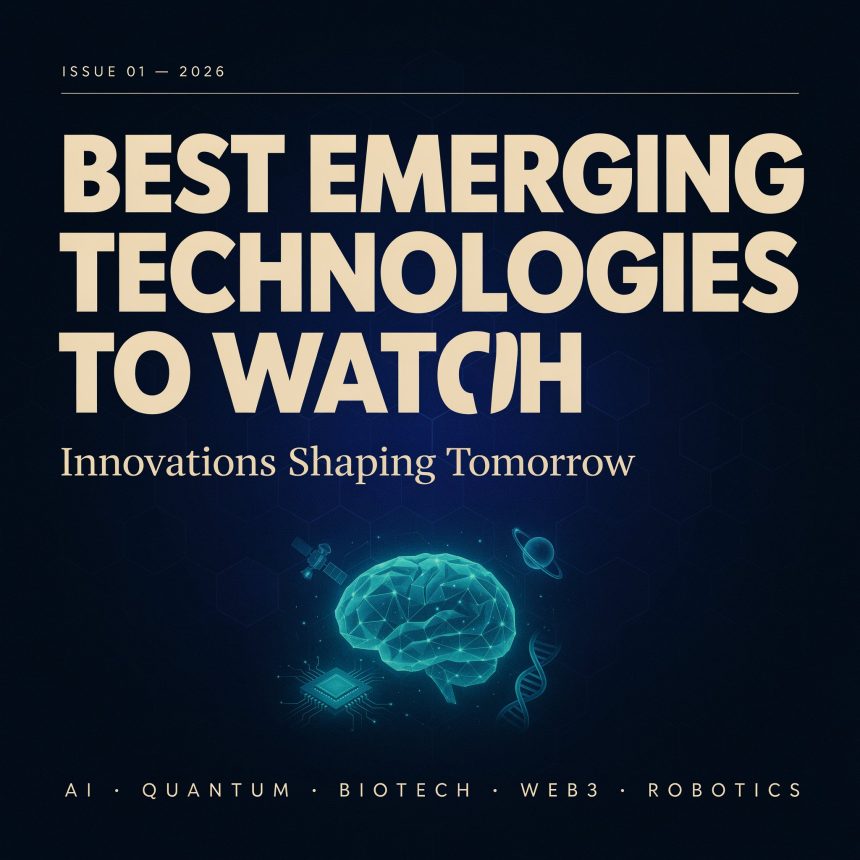
Best Emerging Technologies to Watch: Innovations Shaping Tomorrow
Technology rarely changes the world all at once. Instead, small breakthroughs begin to appear, improve over time, and eventually become part of everyday life. A few years ago, video calls, smart assistants, electric vehicles, and AI-powered tools seemed futuristic to many people. Today, they are increasingly normal.
Now, another wave of innovation is gathering momentum. Artificial intelligence is becoming more capable, robots are learning to work alongside humans, medical science is becoming increasingly personalized, and new computing systems are attempting to solve problems that traditional machines struggle to handle. At the same time, cleaner energy, immersive digital experiences, and connected devices are changing how people interact with the world.
So, which developments are worth watching?
The answer is not simply about finding the flashiest gadget. The most important innovations are often the ones that quietly reshape industries, create new opportunities, and change everyday habits. The technologies below could influence how we work, travel, learn, stay healthy, communicate, and protect our digital lives.
1. Artificial Intelligence Is Moving From Tools to Everyday Partners
Artificial intelligence has become one of the most closely watched areas of innovation, and for good reason. It is no longer limited to research laboratories or large technology companies. AI-powered systems are now helping people write, design, translate, analyze information, create software, and automate repetitive tasks.
A new generation of digital assistance
The next stage is likely to make AI more proactive and personalized. Instead of simply responding to a question, future systems may help organize tasks, summarize complex information, manage digital workflows, and support decision-making.
Imagine AI as a highly capable assistant sitting beside you. It can quickly search through large amounts of information, organize the useful parts, and help you complete routine work. However, you are still the person deciding what matters. That distinction will remain important.
AI across different industries
Healthcare may use intelligent systems to assist with medical research and image analysis. Education could offer more personalized learning experiences. Businesses may automate customer support and administrative work, while scientists could use advanced models to explore complex research questions.
The real impact will come from how widely this capability spreads. AI may become less of a separate product and more like electricity or the internet—a foundation that quietly supports many other services.
The challenges ahead
Powerful AI also raises concerns about misinformation, privacy, bias, employment, and security. The technology will need thoughtful rules and responsible development. Its future success should not be measured only by how intelligent it becomes, but also by how safely and fairly it is used.
2. Robotics Will Become More Flexible and Useful
For decades, robots were mainly associated with factories. They performed repetitive tasks in carefully controlled environments, often separated from human workers.
That is beginning to change.
Modern robots are gaining better cameras, sensors, software, and AI systems. These improvements could allow them to understand their surroundings and handle a wider variety of tasks.
From factories to everyday environments
Future robots may work in warehouses, hospitals, farms, restaurants, construction sites, and homes. Some could deliver goods, transport supplies, inspect dangerous locations, or help with physically demanding work.
A robot operating inside a factory usually follows predictable instructions. A robot working in the real world faces a much harder challenge. People move unexpectedly. Objects are misplaced. Weather changes. Environments are messy.
Making machines capable of dealing with this unpredictability is one of the biggest goals in robotics.
Human-machine teamwork
The most realistic future may not involve robots replacing everyone. Instead, people and machines could divide work according to their strengths.
A robot might lift heavy equipment, repeat precise movements, or operate in dangerous areas. A human can provide judgment, creativity, communication, and emotional understanding.
The workplace of the future may therefore become more collaborative rather than simply more automated.
3. Quantum Computing Could Unlock New Scientific Possibilities
Quantum computing sounds complicated, but its basic importance is easier to understand than the science behind it.
Traditional computers process information using bits, which represent values such as zero or one. Quantum computers use different physical principles that may allow them to handle certain types of calculations in entirely new ways.
They will not necessarily replace laptops, phones, or ordinary computers. Instead, they could become specialized tools for problems that are extremely difficult to solve using conventional systems.
Potential breakthroughs
Researchers are exploring quantum computing for chemistry, materials science, logistics, financial modeling, and cryptography.
One particularly interesting possibility involves molecular simulation. Developing new medicines or materials often requires researchers to understand extremely complex interactions. More powerful computational tools could help accelerate parts of that discovery process.
A new security challenge
Quantum computing could also affect digital security. Some encryption systems used today may eventually become vulnerable to sufficiently powerful quantum machines.
That means cybersecurity experts are already preparing new forms of protection designed for a post-quantum world.
Quantum technology may still require years of development before it reaches its full potential, but its long-term influence could be significant.
4. Biotechnology Is Creating a More Personalized Future
Technology is not only transforming computers and machines. It is also changing how scientists understand living systems.
Biotechnology combines biology with advanced tools, data, automation, and engineering. Its potential reaches healthcare, agriculture, environmental protection, and manufacturing.
Personalized medicine
People do not always respond to treatments in the same way. Future healthcare could use more detailed biological information to help doctors select treatments that are better suited to individual patients.
Instead of relying entirely on broad approaches, medicine could become increasingly personalized.
Gene editing and medical research
Scientists are also developing tools that can study and modify genetic material with greater precision. These technologies may eventually help treat certain inherited conditions and improve our understanding of disease.
However, this progress brings difficult ethical questions.
Just because a technology can do something, should it always be used? Where should society draw the line?
Those questions will require participation from scientists, governments, ethicists, and the public.
Food and agriculture
Biotechnology may also help create crops that are more resilient to disease, extreme weather, or changing environmental conditions. Combined with smarter farming methods, this could help improve food production while reducing waste.
5. Clean Energy Technology Is Becoming a Major Innovation Race
The future will require enormous amounts of energy. Homes, factories, transportation, computing systems, and data centers all depend on reliable electricity.
As digital technology expands, improving how energy is produced and stored will become even more important.
Better batteries
Battery innovation could influence everything from electric vehicles to renewable power storage.
Imagine a solar-powered system producing more electricity than a community needs during the day. Effective storage could save that energy for use at night or during periods of high demand.
Improved batteries could make this process cheaper, safer, and more efficient.
Beyond traditional power
Researchers are exploring new solar technology, hydrogen, advanced storage systems, geothermal energy, and other approaches.
The future energy system may not depend on one revolutionary invention. Instead, it could look like a diversified portfolio, with different technologies supporting one another.
Why energy innovation matters
Every major technological advance needs power. Even artificial intelligence depends on large computing infrastructure.
Cleaner and more efficient energy could therefore become the invisible engine behind many other innovations.
6. Extended Reality Will Blend Digital and Physical Experiences
Virtual reality, augmented reality, and mixed reality are gradually moving beyond entertainment.
Together, these technologies are often described as extended reality. They allow people to experience digital information in more immersive and interactive ways.
Learning by seeing and doing
Imagine learning about ancient history by walking through a virtual reconstruction of an ancient city. Or imagine a student exploring a three-dimensional model of the human body rather than only reading about it in a textbook.
Immersive technology could make certain subjects easier to understand because people can interact with information rather than simply observe it.
A new way to work
Engineers, architects, designers, and medical professionals may also use extended reality for visualization and training.
A team located in different countries could examine the same virtual object as though they were standing in the same room.
Everyday possibilities
As devices become smaller and more comfortable, immersive technology may eventually feel less like a special experience and more like another way of accessing digital information.
7. The Internet of Things Will Make Everyday Objects Smarter
The Internet of Things, often called IoT, connects physical devices to digital networks.
Smart watches, home security systems, connected appliances, and industrial sensors already demonstrate what is possible.
In the future, far more objects may collect and exchange information.
Smarter homes
Connected devices could automatically manage lighting, heating, security, and energy use.
A home might recognize when rooms are empty and reduce unnecessary electricity consumption. Appliances could detect potential problems and notify the owner before a complete failure occurs.
Smarter cities
Cities could use connected sensors to monitor traffic, detect infrastructure problems, manage water systems, and improve public services.
The goal is not simply to collect more information. It is to use information to make systems more efficient.
Security and privacy
There is an important downside. Every connected device can potentially become a target for cyberattacks.
As more everyday objects become digital, strong cybersecurity will become essential.
8. Autonomous Transportation Could Redefine Mobility
Self-driving technology continues to develop, although creating vehicles that can safely handle every real-world situation remains extremely difficult.
Roads are unpredictable. Drivers behave differently. Weather can change quickly. Construction zones appear, and unexpected obstacles can create complex situations.
Despite these challenges, automation is likely to play an increasing role in transportation.
Beyond the self-driving car
Autonomous technology could be used in delivery vehicles, warehouses, agriculture, public transportation, shipping, and drones.
A farm machine, for example, operates in a very different environment from a passenger vehicle navigating a busy city. Some industries may therefore adopt autonomy sooner than others.
Safety and accessibility
If developed responsibly, automated transportation could potentially reduce certain types of accidents caused by human error.
It could also improve mobility for people who are unable to drive independently.
However, safety must remain more important than speed. Technology that controls physical movement needs extremely careful testing.
9. Advanced Connectivity Will Create a More Connected World
Fast and reliable communication networks are becoming essential infrastructure.
New generations of mobile networks, satellite connectivity, edge computing, and improved wireless systems could allow people and devices to communicate more efficiently.
Connecting more than people
The internet was originally designed primarily for people communicating with information and with one another.
The future network will increasingly connect machines as well.
Vehicles may communicate with infrastructure. Factories may coordinate automated equipment. Medical devices could transmit information securely to healthcare professionals.
Edge computing
Some applications cannot afford long delays.
For example, a machine making a rapid safety decision may need to process information almost immediately. Edge computing brings certain computing tasks closer to where information is created, reducing the time needed to send data across distant networks.
Greater access
Better connectivity could also help expand access to education, digital services, remote work, and information in areas that have traditionally faced limited infrastructure.
10. Digital Twins Will Help Us Predict Problems Before They Happen
A digital twin is a virtual representation of a real-world object, building, machine, or system.
It can use sensor data and other information to reflect what is happening in the physical world.
Think of it as a living digital mirror.
Smarter maintenance
Imagine a factory machine with sensors monitoring temperature, vibration, and performance.
If the system detects unusual behavior, it may predict that a component could fail soon. Instead of waiting for a costly breakdown, maintenance teams can act earlier.
Cities and infrastructure
Digital twins could also help planners model transportation networks, energy systems, and buildings.
Before making expensive changes in the real world, they could test different scenarios digitally.
This could save time, reduce waste, and improve decision-making.
11. Cybersecurity Will Become More Intelligent
As technology becomes more powerful and connected, cybersecurity becomes more important.
A digital future without strong protection would be like building a beautiful city and forgetting to install locks on the doors.
Homes, businesses, governments, transportation systems, and healthcare services all depend on digital infrastructure. Protecting that infrastructure will require more advanced approaches.
AI-powered defense
Cybersecurity teams are increasingly using automation to identify unusual activity and respond to potential threats.
Unfortunately, attackers can also use advanced technology.
This creates an ongoing competition between defensive systems and increasingly sophisticated attacks.
Security by design
Future technology should not treat protection as an optional extra.
Security needs to be considered from the beginning when software, connected devices, and digital services are designed.
Encryption, authentication, privacy controls, regular updates, and responsible data management will all remain important.
People are still part of the solution
The strongest technology can still be undermined by a convincing scam or stolen password.
Digital awareness will remain one of the most valuable skills in an increasingly connected world.
12. The Most Important Technology Trend May Be Convergence
Perhaps the biggest development is not a single invention.
It is the way different technologies are beginning to work together.
AI can improve robots. Advanced computing can accelerate biotechnology research. Better networks can connect autonomous systems. Clean energy can support growing digital infrastructure.
These technologies are becoming parts of a larger ecosystem.
The power of combination
A delivery robot, for example, may depend on artificial intelligence to understand its surroundings, advanced sensors to detect obstacles, fast connectivity to exchange information, and strong cybersecurity to prevent interference.
The future is less likely to be shaped by one isolated breakthrough and more likely to emerge from combinations like these.
Preparing for change
For ordinary people, keeping up does not mean learning every technical detail.
It means remaining curious.
Digital skills, critical thinking, adaptability, and a basic understanding of privacy and security will become increasingly valuable.
The people who benefit most from technological change may not always be those who know everything about it. They may simply be the people who are willing to learn and adapt.
Conclusion
The technologies worth watching are not just exciting because they are new. They matter because they could influence the foundations of everyday life.
Artificial intelligence may change how we work and make decisions. Robotics could reshape physical labor. Quantum computing may unlock new scientific possibilities. Biotechnology could transform medicine and agriculture, while clean energy innovation supports a more sustainable technological future.
At the same time, connected devices, immersive experiences, autonomous systems, advanced networks, digital twins, and stronger cybersecurity are creating a world where physical and digital systems are increasingly linked.
The future is still being written. Some of these technologies will develop faster than expected, while others may take decades to reach their full potential. The key is not to predict every invention perfectly. It is to understand the direction of change and remain prepared for the opportunities and challenges ahead.
Frequently Asked Questions
1. What are the most important emerging technologies to watch?
Some of the most influential areas include artificial intelligence, robotics, quantum computing, biotechnology, clean energy, immersive technology, connected devices, autonomous transportation, advanced networks, digital twins, and cybersecurity.
2. Which emerging technology will affect everyday life the most?
Artificial intelligence is likely to have one of the broadest effects because it can be integrated into many different services, industries, and consumer products. However, other technologies may have an equally important impact in specific areas such as healthcare, energy, and transportation.
3. Will emerging technologies create or eliminate jobs?
Both outcomes are possible. Automation may reduce demand for some types of work while creating entirely new roles. The ability to learn new skills and adapt to changing tools will become increasingly important.
4. Are emerging technologies safe?
Technology itself is not automatically safe or unsafe. Its impact depends on how it is designed, tested, regulated, and used. Strong cybersecurity, ethical standards, privacy protections, and responsible development are essential.
5. How can ordinary people prepare for future technology?
You can prepare by improving digital literacy, staying curious, learning how to protect your personal information, developing adaptable skills, and understanding the basic benefits and risks of new technology.