
Modern websites and web applications need to handle growing amounts of information while providing users with fast, reliable experiences. Think about an online shopping store during a holiday sale, a social media platform with millions of active users, or a streaming service delivering content to people around the world. All these platforms depend on databases to store information, process requests, and keep everything running smoothly.
Traditional databases remain an excellent choice for many applications, but some projects need greater flexibility when managing large volumes of changing data.This is where NoSQL databases offer a practical solution. They offer different ways to store information, support distributed systems, and help applications grow as demand increases.
But how do you choose the right database for your project? And what makes one option more suitable than another?
In this guide, we will explore the main types of NoSQL databases, their benefits, popular solutions, practical applications, security considerations, and the challenges developers should understand before choosing a database.
1. What Is a NoSQL Database?
A NoSQL database is a database system that uses data models other than the traditional relational table structure, although some systems support features that overlap with relational databases.
The term NoSQL is commonly understood as “not only SQL.” It describes a broad group of database technologies designed to support different data structures, access patterns, and application requirements.
In a traditional relational database, information is usually organized into tables containing rows and columns. For example, an online store might have separate tables for customers, products, and orders. Relationships connect these tables, allowing the application to retrieve related information.
A NoSQL database may store the same information as documents, key-value pairs, graphs, or wide-column records. The best structure depends on how the application needs to access and update its data.
How does a NoSQL database work?
Imagine that you are organizing a large library. You could place every book’s details into carefully structured tables, or you could store information in individual digital records, organize books by categories, or build a network connecting authors, subjects, and readers.
Each approach has its own advantages. NoSQL databases work in a similar way: they provide different methods for organizing and retrieving information.
For web applications, this flexibility can make it easier to manage user profiles, shopping carts, product catalogs, activity feeds, session information, and other data that may change over time.
However, NoSQL does not automatically mean faster, cheaper, or better than SQL. The right choice depends on the application’s workload, consistency requirements, data relationships, and operational needs.
2. Why Scalable Web Applications Need the Right Database
Scalability is the ability of an application to handle increasing workloads without an unacceptable decline in performance or reliability.
When a website first launches, it might receive only a few hundred visits each day. As the business grows, the same website may need to serve thousands or millions of users. Each visitor can generate database requests by logging in, searching for products, updating a profile, or submitting an order.
If the database cannot keep up, users may experience slow loading times, failed transactions, or temporary service interruptions.
Handling increasing traffic
A scalable database helps applications manage more requests as demand increases. Depending on the technology, this can involve adding computing resources, distributing data across multiple servers, or improving how information is retrieved.
For example, an online marketplace may experience a sudden increase in traffic during a major promotional campaign. A suitable database architecture can distribute workloads across several servers rather than forcing one machine to handle every request.
Managing growing amounts of data
Web applications generate different types of information, including text, images’ metadata, customer activity, product details, and system events. As these records accumulate, storage and retrieval become increasingly important.
Some NoSQL systems can distribute large datasets across multiple machines, allowing storage capacity and processing resources to grow as needed.
Supporting changing business requirements
An application rarely stays the same forever. A shopping platform might begin with basic product listings and later introduce personalized recommendations, customer reviews, live inventory updates, and loyalty programs.
Flexible data models can make these changes easier to implement when the new features require different information fields or structures.
Maintaining a reliable user experience
Scalability is not only about serving more people. It also involves maintaining acceptable performance during busy periods and recovering from hardware or infrastructure failures.
Database replication, monitoring, backups, and appropriate failure-recovery procedures all contribute to reliability. These capabilities vary by product and configuration, so they should be evaluated rather than assumed.
3. Main Types of NoSQL Databases
NoSQL databases are not a single technology. They include several categories, each designed to solve different data-management problems.
Understanding these database types helps you choose the right option for your application’s specific needs.
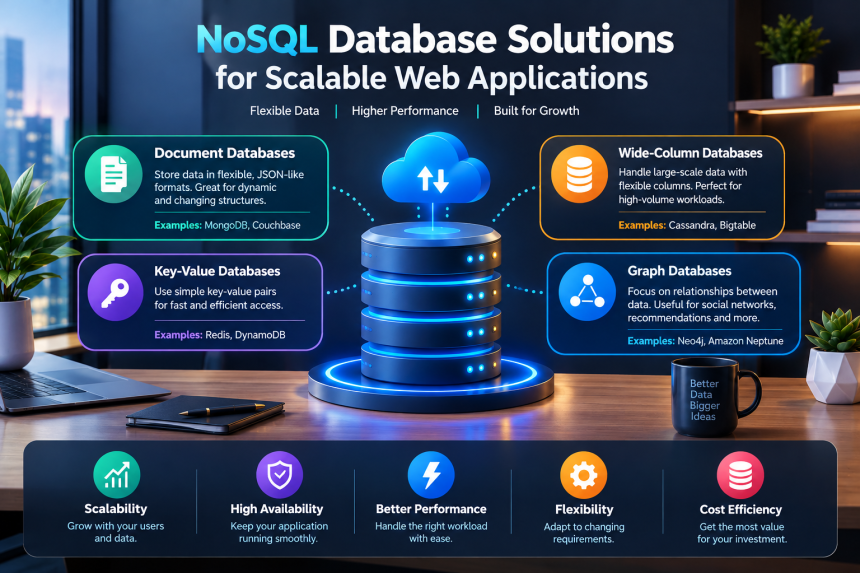
Document databases
Document databases store information in document-like structures, commonly using JSON or a similar format. A document can contain fields, nested objects, arrays, and other related information.
For example, a customer record might include a name, email address, shipping preferences, and a list of saved addresses.
This approach works well when application records have different fields or when related information is often retrieved together.
Document databases are commonly used for content management systems, online stores, customer profiles, and web application backends.
Examples include MongoDB and Couchbase.
Key-value databases
Key-value databases store information as values associated with unique keys. The application supplies a key to retrieve, update, or delete the corresponding value.
Think of a key-value database as a collection of labeled lockers. Each locker has an identifier, and the identifier helps you find its contents quickly.
This model is useful for caching, shopping cart storage, session management, temporary application state, and configuration data.
Redis is a popular example of a key-value technology, although it offers additional data structures and capabilities. Amazon DynamoDB can also be used for key-value workloads.
Wide-column databases
Wide-column databases organize information into rows and flexible collections of columns. They are designed to support particular access patterns across distributed datasets, often at very large scale.
They can be useful for event records, time-series workloads, large analytical datasets, and applications that need to process substantial amounts of information across many machines.
Apache Cassandra and Google Cloud Bigtable are well-known examples.
However, these databases require careful data modeling. Developers generally design tables around the queries an application needs rather than relying on unrestricted joins between tables.
Graph databases
Graph databases represent information as entities and the relationships between them. Entities are commonly called nodes, while connections are called edges.
For example, a social network might represent users as nodes and friendships or follows as connections. The application can then explore relationships to identify mutual friends or recommend people to follow.
Graph databases are especially useful when relationships are central to the application’s purpose.
Common examples include Neo4j and Amazon Neptune.
The key lesson is simple: choose a database model according to your application’s data and queries, not simply because a particular technology is popular.
4. Popular NoSQL Database Solutions for Web Development
Several database platforms are widely used to build modern web applications. They differ in hosting options, data models, management requirements, and pricing.
MongoDB
MongoDB is a document-oriented database that stores records as BSON documents, a binary representation of JSON-like data.
Its flexible document structure is useful for applications where records may contain different fields. Developers can also embed related information within a document when that supports the application’s retrieval patterns.
Common use cases include content platforms, customer management systems, product catalogs, and application backends.
MongoDB offers self-managed deployment options and managed cloud services. The appropriate option depends on your team’s infrastructure skills, performance requirements, and budget.
One important consideration is that flexible schemas do not eliminate the need for data validation. Applications still need clear rules to maintain reliable records.
Amazon DynamoDB
Amazon DynamoDB is a managed NoSQL database service provided by Amazon Web Services.
It supports key-value and document data models and is designed for applications that need predictable performance and the ability to handle changing workloads.
Because AWS manages much of the underlying infrastructure, development teams can focus more on application logic rather than maintaining database servers.
DynamoDB is suitable for use cases such as shopping carts, gaming data, user preferences, and event-driven applications.
Its data model and access patterns require careful planning. Poorly designed partition keys or inefficient queries can create performance or cost problems.
Apache Cassandra
Apache Cassandra is a distributed wide-column database designed for large-scale workloads across multiple nodes.
It is often considered for systems that need high availability, substantial write capacity, and the ability to distribute data across data centers.
Applications involving event collection, messaging activity, device data, or large operational datasets may benefit from its architecture.
Cassandra can be powerful, but it introduces operational and modeling complexity. Teams must understand replication, partitioning, consistency settings, and how their queries map to the database structure.
Redis
Redis is commonly used for in-memory data access, caching, and low-latency operations. Depending on its configuration and deployment, it can also support persistence and replication.
A web application might use Redis to store frequently requested information temporarily, reducing repeated requests to a slower or more expensive primary database.
For example, an online news website could cache popular article details so that thousands of visitors can access them without triggering the same database query every time.
Redis can also support sessions, counters, queues, and real-time features.
However, it is important to choose appropriate memory limits, persistence settings, eviction policies, and security controls.
Google Cloud Firestore
Cloud Firestore is a managed, document-oriented database within Google Cloud and the Firebase ecosystem.
It supports application development through document and collection structures, managed infrastructure, and client SDKs. Its capabilities are particularly useful for certain mobile and web applications.
Firestore can support applications such as collaborative tools, messaging interfaces, and applications that benefit from real-time data updates.
Before choosing it, developers should examine its query limitations, billing model, security rules, and data-access patterns.
There is no universal winner among these platforms. The best solution is the one that matches your application’s requirements and your team’s ability to operate it effectively.
5. Key Benefits of Using NoSQL Databases
NoSQL databases offer several advantages that can help developers build and maintain scalable applications.
Flexible data structures
Many NoSQL databases allow records to contain different fields without requiring every record to follow an identical table structure.
Imagine that an online store begins selling books and later adds clothing, electronics, and furniture. Each product category needs different information. Books may need an author and ISBN, while clothing products need sizes and colors.
A document database can represent these differences naturally.
Nevertheless, flexibility should not become an excuse for inconsistent data. Applications should still validate required fields and maintain sensible standards.
Horizontal scaling
Horizontal scaling means increasing capacity by adding more servers or nodes rather than relying only on a more powerful individual machine.
Some NoSQL databases are designed to distribute data and workloads across multiple nodes. This can help applications grow when one server is no longer sufficient.
The exact process varies by product. Adding nodes may require partition management, capacity planning, or changes to application queries.
High availability
Many NoSQL platforms support replication, which keeps copies of data on multiple machines or in different locations.
If one node becomes unavailable, another copy may continue serving requests, depending on the database configuration and failure conditions.
Replication can improve resilience, but it is not a replacement for independent backups. Accidental deletions or corrupted changes may also be replicated.
Performance for specific workloads
Some NoSQL databases are optimized for particular operations, such as retrieving a document by its identifier, looking up a value by key, or writing large volumes of events.
When the data model matches the workload, these systems can deliver efficient access.
However, performance depends on much more than the database category. Query design, indexing, network latency, hardware, data size, and application behavior all matter.
Support for modern development
Flexible data models and managed database services can help teams build features without maintaining every part of the infrastructure themselves.
This can be valuable for startups, growing businesses, and development teams that need to release improvements regularly.
The greatest benefit comes when the database simplifies the application’s actual requirements rather than adding unnecessary complexity.
6. How to Choose the Right Database for Your Application
Choosing a database is an important architectural decision. Switching later can be expensive because data structures, application queries, and operational procedures become closely connected to the chosen platform.
Before making a decision, consider the following factors.
Understand your data
Start by identifying what your application stores.
Will it contain customer profiles, financial transactions, product listings, messages, device readings, or relationships between users?
Consider whether records have consistent structures or whether different records require different fields. Also examine how frequently the information changes and how long it must be retained.
Identify your main queries
Think about how users and application services will retrieve information.
Will they look up records by identifier? Search across many fields? Filter products by several characteristics? Explore complex relationships? Generate reports from historical information?
Your most important queries should influence the database model.
For example, a document database may suit a product catalog where each product’s details are retrieved together. A graph database may be more suitable when the application frequently explores complex relationships.
Estimate traffic and growth
Consider the expected number of users, requests per second, record sizes, and daily data growth.
You do not need a perfect forecast, but you should understand likely growth patterns and periods of unusually high demand.
A database suitable for a small website may not be appropriate for a service that processes millions of events daily.
Evaluate consistency requirements
Consistency describes how reliably users see updated information across database operations and replicas.
For example, a social media feed may tolerate a brief delay before every user sees a new post. A payment system generally needs stronger guarantees around transaction processing and account balances.
Different databases offer different consistency and transaction capabilities. Some support strong consistency for particular operations, while others allow configurable trade-offs.
Compare total cost
Database costs include more than the advertised hosting price.
You should consider storage, request volume, data transfer, backups, monitoring, support, development time, and the expertise needed to maintain the system.
A managed database may cost more per unit of infrastructure but save substantial engineering time.
The right solution balances performance, reliability, cost, and maintainability.
7. Best Practices for Building Scalable Applications
Selecting a suitable database is only the beginning. The way you design, query, and maintain it determines how effectively it supports your application.
Design data around access patterns
In many NoSQL systems, developers organize information around the operations the application performs most frequently.
For instance, if a customer dashboard usually displays a customer’s profile and recent orders together, the data model should make that retrieval efficient.
This does not mean copying every field everywhere. It means understanding the trade-offs between storing related information together and maintaining separate records.
Use indexes carefully
Indexes help databases locate information without examining every record.
An index can improve queries that filter or sort records by particular fields. However, indexes consume storage and can increase the cost of writes because they must be updated when data changes.
Create indexes for important queries, measure their effectiveness, and remove unnecessary ones when appropriate.
Implement caching
Caching stores frequently requested information in a location where it can be accessed quickly.
For example, an application could cache product categories, public settings, or popular articles instead of repeatedly reading the same information from its main database.
Caching can reduce database load and improve response times. However, it introduces a challenge: keeping cached information sufficiently up to date.
Define expiration rules and invalidation strategies based on how quickly the underlying data changes.
Monitor performance
Monitoring helps you identify problems before they significantly affect users.
Useful measurements include request latency, error rates, database throughput, storage usage, replication delays, and resource consumption.
You should also monitor application-level behavior. A slow database query may be caused by an inefficient endpoint or an unexpected increase in traffic.
Regular testing under realistic workloads can reveal bottlenecks before an application experiences rapid growth.
Plan for failure
Even well-designed systems can experience hardware problems, network interruptions, software errors, or accidental data loss.
Maintain tested backups, document recovery procedures, and establish realistic recovery objectives. Test what happens when a database node becomes unavailable.
A scalable application should not merely perform well on an ordinary day. It should also have a sensible plan for unusual situations.
8. Security and Data Protection in NoSQL Systems
Scalability means little if an application cannot protect its information. Database security should be part of the initial design rather than something added after a problem occurs.
Control access
Use role-based permissions and grant each application service only the access it needs.
For example, a service that reads product information should not automatically receive permission to delete customer records or modify administrative settings.
Avoid shared administrative accounts and rotate credentials according to your security policies.
Protect information in transit and at rest
Encryption helps protect information from unauthorized access.
Use secure connections between applications and databases. Enable appropriate encryption for stored data, backups, and snapshots, while managing encryption keys securely.
Encryption is only one layer of protection, so it should complement authentication, access controls, and monitoring.
Validate application input
Flexible data structures can make input validation especially important.
An application should verify that submitted information has the expected type, format, and permitted values. It should also use safe query-building practices and avoid allowing user input to change the intended meaning of a database query.
For example, a profile form should reject invalid email addresses and unexpected fields when those fields are not supported.
Protect backups and audit activity
Backups should be protected against unauthorized access and accidental deletion. For important systems, consider separate access controls and copies that are isolated from routine application operations.
Audit logs can help teams investigate suspicious access, identify configuration changes, and understand what happened during an incident.
Organizations should also consider privacy obligations, data-retention policies, and applicable regulations when storing personal information.
Security is an ongoing responsibility. Regular updates, configuration reviews, access checks, and recovery exercises help maintain protection as the application grows.
9. Common Challenges and How to Overcome Them
NoSQL databases can solve important problems, but they also introduce trade-offs that developers should understand.
Limited or different query capabilities
Some NoSQL systems do not support the same joins and ad hoc query patterns commonly found in relational databases.
As a result, developers may need to store related data together, maintain additional indexes, or create separate records for different access patterns.
The best response is to define important queries early and test whether the chosen database supports them efficiently.
Data duplication
Some NoSQL designs deliberately duplicate information to make common reads faster.
For example, a product’s name might appear in several records so that the application can retrieve each record without an additional lookup.
The disadvantage is that changes may need to be applied to multiple copies. Without a clear update strategy, different records can contain conflicting information.
Use duplication deliberately and establish a reliable method for keeping copies synchronized.
Consistency trade-offs
Distributed databases may need to balance availability, latency, and consistency under particular failure conditions.
This can affect how quickly updates become visible across replicas and whether conflicting changes are possible.
Developers should understand the consistency guarantees of their chosen system and identify which operations require stronger guarantees.
Vendor dependence
Managed database services often simplify operations, but they can create dependence on a particular provider’s features, query language, and infrastructure.
Moving to another provider may require changes to application code and data structures.
You can reduce unnecessary dependence by documenting architecture decisions, separating database access behind clear application interfaces, and assessing migration costs before committing to a platform.
Unexpected costs
Usage-based pricing can become difficult to predict when traffic, storage, or request volume increases.
Monitor consumption, test realistic workloads, and configure budget alerts where available. Review expensive queries and avoid unnecessary data transfers.
Careful planning helps teams benefit from managed services without losing control of operational spending.
10. Real-World Applications of NoSQL Databases
NoSQL technologies support many familiar digital services. Their usefulness becomes clearer when we examine specific scenarios.
E-commerce websites
Online stores manage product information, customer preferences, shopping carts, browsing activity, and inventory.
A document database may store flexible product catalogs, while a key-value database may provide fast access to shopping cart information.
However, orders, payments, and inventory updates require appropriate transaction and consistency guarantees. The best architecture may combine NoSQL and relational databases rather than forcing every task into one system.
Social media platforms
Social networks handle user profiles, posts, comments, reactions, and activity feeds.
Document databases can store content, while key-value systems may support caching and short-lived application state. Graph databases can help analyze connections between users.
Different components can use different databases because their data structures and access patterns are not identical.
Streaming and gaming services
Streaming platforms collect playback events, preferences, viewing histories, and service metrics.
Online games may need to store player settings, match histories, rankings, and session data.
Wide-column and key-value databases can be useful for high-volume workloads, depending on the required queries and consistency guarantees.
Internet of Things applications
Connected devices can produce continuous streams of readings, such as temperature, equipment status, or energy consumption.
Distributed databases can help manage large volumes of these records. However, teams must also consider retention, aggregation, time-based queries, and whether a dedicated time-series database would be more suitable.
Content management systems
Content platforms manage articles, images’ metadata, categories, author details, and publishing settings.
Document databases can represent different content types with their own fields. This can simplify the development of platforms where content structures change frequently.
Across all these examples, the central principle is the same: select technologies according to the information being stored, the operations being performed, and the experience users expect.
11. The Future of NoSQL and Modern Database Architecture
Database technology continues to evolve as applications become more connected, data-intensive, and dependent on real-time information.
One important trend is the growing use of managed and serverless database services. These services reduce the amount of infrastructure developers need to maintain and can adjust capacity according to workload, depending on the provider and configuration.
Another trend is the combination of different database technologies within the same application. Rather than relying on one database for every purpose, teams increasingly choose specialized systems for transactional records, caching, search, analytics, and relationship analysis.
For example, a modern shopping platform might use a relational database for orders, a document database for product details, a cache for frequently requested information, and a search engine for product discovery.
This approach is sometimes called polyglot persistence. It can provide flexibility, but it also creates more systems to monitor, secure, and maintain.
Artificial intelligence is another area influencing database design. Applications that support semantic search and AI-powered recommendations may use vector indexes or specialized vector databases to find information based on similarity rather than exact keyword matches.
Some existing database platforms offer vector search capabilities, while other projects use dedicated solutions. The right choice depends on data volume, search quality, latency, and integration requirements.
Despite these developments, the fundamentals remain unchanged. Developers still need to understand their data, select suitable access patterns, control costs, protect sensitive information, and test performance under realistic conditions.
New technology can expand what an application can do, but good database design remains essential.
Conclusion
NoSQL databases provide valuable options for building web applications that need flexible data structures, distributed storage, and efficient access to information. Document, key-value, wide-column, and graph databases each serve different purposes, and platforms such as MongoDB, DynamoDB, Cassandra, Redis, and Firestore offer different combinations of capabilities.
However, choosing a database should never be based on popularity alone. You should consider your application’s data model, query patterns, consistency requirements, security needs, expected growth, and budget.
For some projects, a NoSQL database will be the best fit. For others, a relational database or a combination of technologies will provide a more reliable solution.
Ultimately, a scalable application is built by making informed decisions, testing assumptions, and improving the system as real-world requirements evolve. When your database matches your workload and your team understands its trade-offs, you can build web experiences that remain responsive and dependable as demand grows.
Frequently Asked Questions (FAQs)
1. What is the best NoSQL database for scalable web applications?
There is no single best choice for every application. MongoDB is useful for flexible document structures, DynamoDB supports managed key-value and document workloads, Cassandra is designed for distributed wide-column workloads, and Redis is often used for caching and low-latency data access. The best option depends on your application’s requirements.
2. Are NoSQL databases better than SQL databases?
Not necessarily. NoSQL databases can be suitable for flexible data models, distributed workloads, and specific high-volume access patterns. SQL databases are often preferable when applications rely on structured relationships, complex queries, and strong transactional guarantees. Some systems benefit from using both.
3. Can NoSQL databases handle millions of users?
Yes, many NoSQL systems can support applications with millions of users when appropriately designed and configured. Actual capacity depends on request volume, data size, query patterns, infrastructure, and application architecture. Testing and monitoring are essential for maintaining performance as usage grows.
4. Are NoSQL databases secure for business applications?
Yes, NoSQL databases can be used securely for business applications when configured and managed properly. Important measures include strong authentication, least-privilege access, encryption, input validation, protected backups, monitoring, and regular security updates. Security depends on implementation, not simply on the database category.
5. Can I use multiple NoSQL databases in one web application?
Yes. An application can use different databases for different tasks. For example, it might use MongoDB for product information, Redis for caching, and Cassandra for high-volume event records. This can improve suitability for individual workloads, but it also increases operational complexity, so each additional database should have a clear purpose.