
An AI voice generator can turn written words into natural-sounding speech in seconds. What once required a recording studio, microphone, voice actor, and editing software can now be handled through a simple online tool. From videos and podcasts to accessibility and educational content, this technology is changing how people create and consume audio.
But how does it work, what can you actually use it for, and how do you choose a suitable tool? Let’s explore the technology in simple terms and look at what makes modern synthetic speech so useful.
What Is an AI Voice Generator?
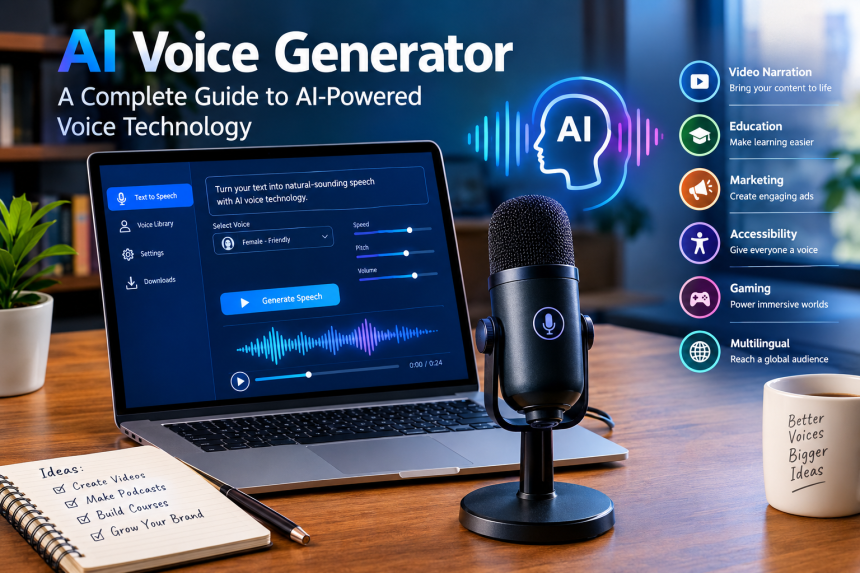
An AI voice generator is software that converts written text into spoken audio using artificial intelligence. You provide a script, select a voice, adjust available settings, and generate an audio file.
Older text-to-speech systems often sounded mechanical. Modern systems can produce speech with changes in pace, pauses, emphasis, pronunciation, and tone. The result can sound much closer to an actual person speaking.
Think of it like having a virtual narrator sitting beside you. Instead of reading every sentence into a microphone yourself, you give the system the words and it produces the narration.
These tools can offer different voices, languages, accents, and speaking styles. Some are designed for straightforward narration, while others focus on expressive performances for videos, advertisements, stories, or interactive applications.
The technology is also becoming easier for ordinary users. You do not necessarily need audio engineering knowledge to create useful voice content. In most cases, the process is straightforward and involves just a few simple steps:
- Write or paste your script.
- Choose a voice.
- Adjust the delivery if the tool provides controls.
- Generate the speech.
- Listen and make corrections.
- Export the finished audio.
That simplicity is one reason synthetic speech has moved beyond specialist software and into everyday content creation.
How Does AI Speech Technology Work?
At a basic level, the process begins with text. The system analyzes the written language and determines how the words should be spoken.
Modern systems can consider punctuation, sentence structure, word pronunciation, and context. The software then produces an audio representation of the intended speech.
The exact technology varies between platforms, but many modern systems use neural networks trained on large amounts of speech data. During development, these systems learn patterns connecting language with human speech.
For example, the same written sentence can sound very different depending on where a pause occurs or which word receives emphasis. Advanced systems attempt to capture those details rather than simply reading each word individually.
Natural pacing
Good synthetic speech should not sound as though every word has been placed at exactly the same distance from the next one. Natural speakers speed up, slow down, pause, and change their delivery depending on the meaning.
Pronunciation
Words can be surprisingly complicated for software. Names, abbreviations, technical vocabulary, and words with multiple meanings can create problems. Better systems provide pronunciation controls or contextual processing to handle these situations.
Expression
Some platforms allow users to influence characteristics such as energy, warmth, seriousness, or enthusiasm. These features can be especially useful when creating storytelling or promotional material.
The important point is that the system is not simply pressing a digital “play” button on a dictionary. It is attempting to transform written language into a convincing spoken performance.
Why Has This Technology Become So Popular?
One major reason is convenience. Recording traditional narration can take considerable time. You need suitable equipment, a quiet environment, and someone capable of delivering the script consistently.
Synthetic speech removes many of those requirements.
Imagine you have written a ten-minute educational video and discover a spelling mistake after recording the entire narration. With a traditional recording, you may need to record the affected section again and edit it into the project. With a digital voice system, you can often correct the text and regenerate the relevant section.
Cost is another factor. Professional voice production can involve recording, editing, studio time, and talent fees. AI-based tools can make smaller projects more accessible, although professional human narration remains valuable for many situations.
There is also the matter of scalability. A business may need hundreds of product descriptions, training lessons, announcements, or localized audio files. Producing every version manually can be difficult.
Automated speech can help organizations produce large volumes of consistent audio.
The technology also supports multilingual communication. Instead of creating separate recordings from scratch for every language, organizations can generate localized versions where appropriate.
However, while the technology offers great convenience, it still has limitations and isn’t perfect. AI speech still requires human review, particularly when the content is important, sensitive, highly technical, or intended to represent a brand.
Common Uses of AI-Generated Voices
The range of applications is much wider than many people realize. Voice synthesis is now useful in entertainment, education, marketing, accessibility, software, and personal projects.
Video narration
Creators can use generated speech for tutorials, explainers, documentaries, presentations, and other videos. This is useful when the creator does not want to record their own voice.
Podcasts
Some publishers use synthetic voices for certain podcast formats, especially when producing informational material at scale. Human hosts can still provide personality and emotional connection, but generated narration can be practical for specific formats.
Educational content
Teachers, course creators, and publishers can turn written lessons into audio. Students may benefit from having another way to consume educational material, particularly when listening is more convenient than reading.
Accessibility
Speech technology can help people access written information through audio. It can be used in applications that read digital text, documents, interfaces, or other material aloud.
Marketing
Businesses can produce narration for advertisements, product demonstrations, social media clips, and promotional presentations.
Games and interactive experiences
Developers can use generated speech for characters, instructions, notifications, and other interactive elements. This can be particularly useful during development when a project needs temporary or large volumes of dialogue.
Training and internal communication
Companies can turn written procedures and training material into spoken lessons. This can make certain types of workplace content easier to consume.
Personal projects
You can also use these tools for audiobooks, presentations, language practice, storytelling, announcements, and experiments.
The best application depends on the project. A voice that works perfectly for a short tutorial may feel unsuitable for a dramatic story, so voice selection matters.
What Makes a Voice Sound Natural?
Naturalness is more complicated than simply making a voice clear.
When humans speak, we constantly make tiny adjustments. We pause before an important point, change our pitch, emphasize certain words, and alter our pace depending on the listener.
A convincing synthetic voice needs to reproduce at least some of these characteristics.
Rhythm and pacing
If every sentence is delivered at the same speed, the result can become tiring. Good pacing gives the listener enough time to understand the information without making the narration unnecessarily slow.
Pauses
Punctuation can influence pauses, but some systems offer additional controls. A carefully placed pause can make an explanation easier to follow.
Emphasis
Consider the difference between casually mentioning a fact and emphasizing the most important part of that fact. Vocal emphasis can guide attention.
Tone
A serious subject usually benefits from a different delivery than an entertaining social media video. The voice should match the purpose of the content.
Pronunciation
Even an otherwise excellent voice can sound unnatural if it mispronounces a person’s name, company, place, or specialized term.
This is why listening to the complete output is important. Never assume that grammatically correct text will automatically produce perfect speech.
Choosing the Right Voice for Your Content
There is no single voice that works for every project.
Before selecting one, think about the audience. Who will hear this content? What are you trying to communicate? Should the delivery feel professional, friendly, calm, energetic, informative, or conversational?
A technology tutorial might benefit from a clear and steady narrator. A children’s story could require more expressive delivery. A corporate training lesson may need a calm and professional style.
Match the voice to the subject
The voice should support the message rather than compete with it. An overly dramatic voice can distract from a simple explanation, while an extremely flat delivery may weaken an emotional story.
Consider pronunciation
If your script contains unusual names or industry-specific vocabulary, test those sections before producing the complete project.
Check language and accent options
If your audience is international, make sure the selected voice handles the required language naturally. An accent is not merely a cosmetic setting; pronunciation and rhythm can affect how comfortable the content is to hear.
Listen at normal speed
A voice may sound impressive in a short preview but become tiring during a ten-minute narration. Always evaluate it in the context of your actual project.
Think about consistency
If you are producing a series, consistency matters. Changing voices from one episode to another can make the content feel less connected.
AI Voice Generators vs. Human Voice Actors
Does generated speech mean human voice actors are no longer useful? Not necessarily.
The two approaches have different strengths.
Human performers bring interpretation, personality, emotion, timing, and creative judgment to a recording. For films, major advertisements, character performances, and emotionally sensitive projects, those qualities can be extremely important.
Generated voices offer speed, repeatability, scalability, and convenience. They can be useful when a project requires frequent updates or large amounts of narration.
Think of the difference like automated photography and professional photography. A phone camera can produce an excellent image quickly, but professional photographers still have a role when artistic direction, experience, and human judgment matter.
The same idea applies to speech.
For a simple instructional video, synthetic narration may be sufficient. For a major commercial campaign, a human performance may be preferred because the voice itself is part of the creative identity.
There is also a hybrid approach. A project can combine human narration with generated speech for smaller sections, temporary drafts, translations, or routine announcements.
The right choice depends on the purpose, budget, audience, and required level of creative control.
Benefits and Limitations to Consider
The technology offers impressive advantages, but responsible use requires understanding its limitations.
Major benefits
- Fast audio production
- Easy script revisions
- Large selection of voices
- Support for multiple languages
- Useful for accessibility
- Consistent delivery
- Convenient for large projects
- Lower production barriers for beginners
For a solo creator, these advantages can save significant time.
However, limitations remain.
Emotional depth
Generated speech can sound expressive, but it may not always reproduce the subtle emotional decisions of a skilled human performer.
Pronunciation mistakes
Unusual words and names can still cause errors. Human review is therefore important.
Contextual misunderstandings
A written sentence can sometimes be interpreted in different ways. The system may choose a delivery that does not match what you intended.
Overuse
If every piece of online content uses similar synthetic narration, audiences may begin to notice repetitive patterns.
Licensing
Voice and audio rights vary between providers and plans. Before using generated audio commercially, read the applicable terms carefully.
Identity and consent
The use of a person’s recognizable voice raises important ethical and legal questions. A voice should not be cloned or imitated without appropriate authorization.
Understanding these limitations helps users treat the technology as a creative tool rather than a magical replacement for every form of professional audio production.
Voice Cloning, Ethics, and Responsible Use
Voice cloning deserves special attention because it can reproduce characteristics associated with a particular speaker.
There are legitimate applications. A person may want an authorized digital version of their own voice for accessibility, content production, or personal projects. Organizations may also have carefully managed voice assets with appropriate permissions.
But there are obvious risks when someone else’s voice is reproduced without consent.
A synthetic recording can potentially make it appear that someone said something they never said. That creates problems involving deception, reputation, privacy, fraud, and intellectual property.
For this reason, users should approach voice cloning with caution.
Get permission
If a voice belongs to another person, obtain clear authorization before cloning or commercially using it.
Be transparent
When synthetic speech could reasonably be mistaken for a real person’s statement, disclosure can help prevent confusion.
Protect personal information
Voice data can be sensitive. Understand how a provider stores, processes, and protects recordings and voice models.
Review commercial rights
A platform may allow you to generate audio for personal use while applying different rules to commercial projects. Always check the relevant license.
Responsible use is not simply about following platform rules. It is also about respecting the person whose identity or voice is involved.
How to Create Better AI Narration
You do not need to be an audio professional to improve the quality of generated narration.
Start with the script.
Short, clear sentences are generally easier to deliver naturally than extremely long sentences packed with information. Write for the ear, not just the eye.
Use natural punctuation
Commas, periods, and paragraph breaks can influence the rhythm of narration. If a sentence feels difficult to read aloud yourself, it may also need improvement before synthesis.
Write conversationally
Instead of creating unnecessarily formal sentences, imagine that you are explaining the subject to another person.
Test difficult words
Names, abbreviations, numbers, technical terms, and unusual spellings deserve special attention.
Break large scripts into sections
Producing shorter sections can make editing easier. If one sentence needs correction, you do not necessarily need to regenerate an entire long recording.
Listen before publishing
This sounds obvious, but it is one of the most important steps. Read along with the audio and check pronunciation, pauses, pacing, and overall tone.
Edit the final audio when needed
Generated narration can be combined with music, sound effects, captions, or other production elements. Keep background audio subtle enough that listeners can understand every word.
The goal is not simply to make a computer speak. The goal is to create an audio experience that feels clear and useful to the listener.
The Future of Synthetic Speech
Voice technology is likely to become more capable as language models, speech systems, and audio processing continue to develop.
We can expect improvements in expressive delivery, multilingual communication, pronunciation, real-time interaction, and personalization.
Imagine digital assistants that can change their communication style depending on the situation, educational applications that explain difficult topics conversationally, or software that provides natural spoken guidance while you work.
At the same time, the more realistic synthetic speech becomes, the more important transparency and consent will become.
The future is therefore not simply about making artificial voices sound human. It is also about creating systems that people can use safely and responsibly.
For everyday users, this means learning both sides of the technology: what it can do and where caution is necessary.
Conclusion
AI voice technology has made spoken content faster and more accessible to creators, businesses, educators, developers, and everyday users. It can turn a written script into useful narration without requiring traditional recording equipment or extensive production skills.
Its greatest strength is flexibility. You can use it for videos, learning material, accessibility, presentations, marketing, software, and many other projects. At the same time, pronunciation, emotional expression, licensing, privacy, and consent still require human attention.
Used thoughtfully, synthetic speech is best viewed as a tool that expands what you can create rather than something that eliminates the need for human creativity.
Frequently Asked Questions
1. What is an AI voice generator?
It is a software system that converts written text into spoken audio using artificial intelligence and speech synthesis technology.
2. Can AI-generated speech sound like a real person?
Yes. Modern systems can produce highly natural speech with realistic pacing, pronunciation, pauses, and changes in delivery. However, quality varies between tools and voices.
3. Can I use generated voices for YouTube videos?
Many platforms allow generated audio to be used in content, but the exact commercial and licensing terms depend on the provider and subscription. Always check the applicable usage rights before publishing monetized content.
4. Is voice cloning legal?
The answer depends on the circumstances, jurisdiction, permissions, and intended use. Cloning another person’s recognizable voice without authorization can create serious legal and ethical concerns, so obtaining appropriate consent is important.
5. What should I check before publishing AI narration?
Listen to the complete recording and check pronunciation, pacing, pauses, tone, factual accuracy, audio quality, licensing, and whether the voice or material has been used with the necessary permission.