
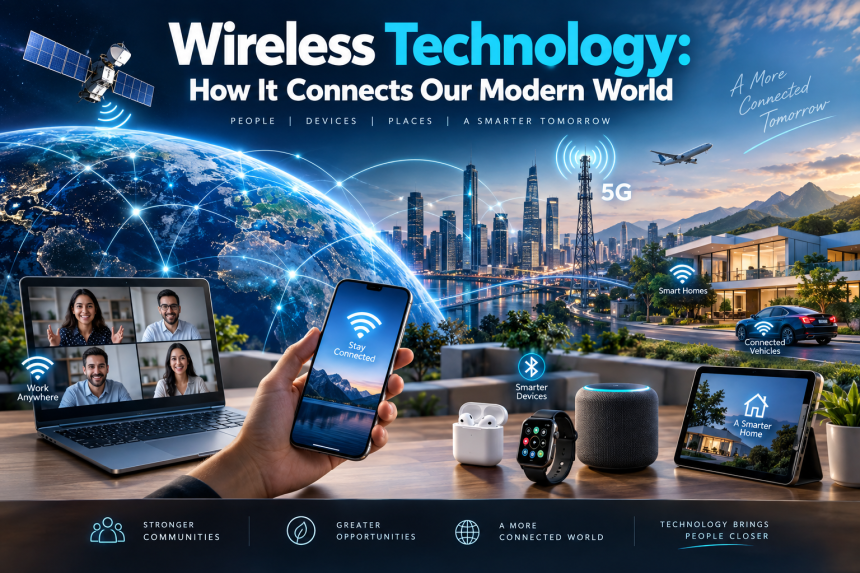
Imagine waking up in the morning and checking your phone without plugging it into a wall. You connect to the internet through Wi-Fi, listen to music using Bluetooth earbuds, pay for coffee by tapping your phone, and use GPS to find your destination. Throughout the day, you may connect with people, devices, services, and information without ever thinking about the invisible signals making it all possible.
That is the power of wireless technology.
Wireless communication has changed the way we live, work, travel, learn, and communicate. What once seemed like science fiction is now part of everyday life. From smartphones and smart homes to satellites and connected vehicles, wireless systems are helping create a world where information can move freely without physical cables.
But how does this technology actually work? Why has it become so important? What are its benefits and challenges, and what might the future look like?
This article explores the world of wireless communication in simple language and explains why it has become one of the most important foundations of modern society.
What Is Wireless Technology?
Wireless technology refers to the transfer of information between devices without using physical cables or wires.
Instead of sending information through a wire, wireless systems use signals that travel through the air or space. These signals can carry different types of information, including voice, text, images, videos, and data.
For example, when you send a message from your smartphone, information travels from your device to a wireless network. The network processes the information and sends it to another device. All of this can happen in just seconds.
Wireless communication can use several methods, including:
- Radio waves
- Infrared signals
- Microwaves
- Satellite signals
- Bluetooth connections
- Wi-Fi networks
- Cellular networks
Think of wireless communication like an invisible highway in the sky. Cars cannot be seen driving on this highway, but information is constantly moving from one place to another.
This invisible system allows people and devices to communicate across a room, across a city, or even across the world.
A Brief History of Wireless Communication
Wireless communication may feel like a modern invention, but its history goes back more than a century.
Early communication systems depended heavily on physical connections. Telegraph lines and telephone cables made it possible to send information over long distances, but they required large networks of wires.
The development of radio communication changed everything.
Scientists and inventors discovered that electromagnetic waves could carry signals through the air. This made it possible to send information without connecting two locations with a physical cable.
Over time, wireless communication developed rapidly.
Radio communication allowed messages and broadcasts to travel over long distances.
Television brought moving images and entertainment into homes.
Mobile phones made communication portable.
Wi-Fi allowed computers and other devices to access local internet networks without cables.
Bluetooth made it possible for nearby devices to communicate easily.
Today, wireless systems support billions of connected devices around the world.
The journey from simple radio signals to modern mobile networks shows how quickly technology can transform society.
How Wireless Communication Works
Wireless communication may sound complicated, but the basic idea is easier to understand than many people think.
A wireless system usually involves three main steps:
Sending information
A device creates information that needs to be transmitted. This could be a voice call, text message, video, or internet request.
Transmitting a signal
The device converts the information into a signal and sends it through the air using a transmitter and antenna.
Receiving information
Another device receives the signal and converts it back into useful information.
For example, imagine you are talking to someone using a mobile phone.
Your voice is converted into digital information. Your phone sends that information to a nearby network tower. The network then directs the information toward the other person’s phone. Their device converts the information back into sound.
This process happens incredibly quickly.
Wireless systems use different frequencies to organize communication. You can think of frequencies like different lanes on a highway. Multiple signals can travel through the air without completely interfering with each other because they use different channels and systems.
Of course, modern networks are much more advanced than this simple explanation, but the basic principle remains the same: information is converted into signals, transmitted, received, and converted back into something useful.
Wi-Fi and the Wireless Internet Experience
For many people, Wi-Fi is the most familiar example of wireless connectivity.
Wi-Fi allows devices such as smartphones, laptops, tablets, smart televisions, and gaming systems to connect to a local network without using physical internet cables.
Most homes now depend on Wi-Fi for everyday activities.
People use it to:
- Stream movies
- Attend online meetings
- Play games
- Browse websites
- Study online
- Control smart devices
- Communicate with friends and family
A typical Wi-Fi setup includes a router that sends and receives wireless signals. Devices within range can connect to the network and access the internet.
The quality of the connection can depend on several factors, including distance, walls, interference, network traffic, and the capabilities of the router.
Have you ever noticed that your connection becomes weaker when you move far away from the router? That happens because wireless signals can lose strength as they travel through walls, furniture, and other obstacles.
Modern Wi-Fi systems continue to improve, offering faster speeds, better coverage, and stronger connections for households with many connected devices.
As more appliances and gadgets become connected, reliable home networks will become even more important.
Bluetooth and Short-Range Connectivity
Bluetooth is another major part of everyday digital life.
Unlike Wi-Fi, which is often used for internet access and network connections, Bluetooth is mainly designed for communication between devices that are relatively close to each other.
You probably use Bluetooth more often than you realize.
Common Bluetooth devices include:
- Wireless earbuds
- Smartwatches
- Wireless keyboards
- Computer mice
- Speakers
- Fitness trackers
- Vehicle systems
For example, when you connect wireless earbuds to your smartphone, Bluetooth creates a connection between the two devices. Audio information travels wirelessly from the phone to the earbuds.
One of Bluetooth’s biggest advantages is convenience.
You no longer need to deal with tangled headphone wires or physical connections between many accessories. A simple pairing process can connect devices within seconds.
Bluetooth technology has also become more energy efficient over time. This is especially important for small devices that depend on batteries.
Wearable technology, health devices, smart home products, and portable electronics all benefit from low-power wireless connections.
Cellular Networks and Mobile Communication
Mobile networks have completely transformed communication.
Before smartphones became common, people depended mainly on landline phones, desktop computers, and fixed internet connections. Today, mobile devices allow people to communicate and access information almost anywhere.
Cellular networks are made up of many connected coverage areas, often supported by network towers and other infrastructure.
When you move from one area to another, your phone can connect to different parts of the network. This allows you to remain connected while traveling.
Mobile networks have evolved through several generations.
Early mobile systems focused mainly on voice communication.
Later generations introduced text messaging and basic data services.
Modern networks support high-speed internet, video streaming, online gaming, navigation, cloud services, and many other digital activities.
The introduction of advanced mobile connectivity has also supported new technologies beyond smartphones.
Connected vehicles, industrial equipment, smart infrastructure, and remote systems can all benefit from fast and reliable mobile networks.
This means cellular technology is no longer just about making phone calls. It has become an important part of the global digital economy.
The Role of Wireless Technology in Smartphones
Smartphones are one of the best examples of how multiple wireless systems can work together.
A modern smartphone may include support for:
- Cellular communication
- Wi-Fi
- Bluetooth
- GPS
- Near-field communication
- Mobile data
- Satellite connectivity in some situations
Each connection serves a different purpose.
Wi-Fi helps users connect to local internet networks.
Bluetooth connects accessories such as headphones and watches.
GPS helps determine location and navigation.
Cellular networks provide mobile calls and internet access.
Near-field communication, often called NFC, can support contactless payments and quick connections.
Because of these technologies, a smartphone has become much more than a phone.
It can act as a camera, navigation device, payment tool, entertainment center, communication platform, and personal assistant.
The ability to connect wirelessly is one of the main reasons smartphones have become so useful.
Without these invisible connections, the modern smartphone experience would be very different.
Wireless Technology in Homes and Everyday Life
The rise of smart homes has created another major use for wireless systems.
A smart home contains devices that can communicate, connect, and sometimes operate automatically.
Examples include:
- Smart lights
- Security cameras
- Smart speakers
- Connected doorbells
- Thermostats
- Home appliances
- Smart locks
Imagine arriving home and using your phone to unlock the door, turn on the lights, and adjust the temperature. These actions may depend on wireless communication between your devices and home systems.
This level of convenience can make daily life easier.
However, smart homes also require good planning. More connected devices mean more dependence on reliable networks.
Security is also important. Every connected device can potentially become a point of access if it is not properly protected.
That is why users should keep devices updated, use strong passwords, and follow good security practices.
The smart home is like an orchestra. Each device has a different role, but wireless connectivity helps them work together.
Wireless Technology in Healthcare
Healthcare is another area where wireless communication is creating important changes.
Connected devices can help doctors and patients share information more quickly and conveniently.
Wearable devices can monitor things such as:
- Physical activity
- Heart-related information
- Sleep patterns
- Movement
- Fitness progress
Some medical systems can also transmit information to healthcare professionals from remote locations.
This can be especially helpful for people who live far away from hospitals or medical facilities.
Wireless communication can also support remote consultations. Patients may be able to speak with healthcare professionals through video services instead of traveling long distances for certain appointments.
Hospitals also use connected systems to communicate, manage equipment, and access important information.
Of course, healthcare technology requires strong privacy and security protections. Medical information is sensitive, so organizations must carefully protect the data they collect and transmit.
As technology improves, connected health systems may continue to make healthcare more accessible and efficient.
Wireless Connectivity in Transportation
Transportation is becoming increasingly connected.
Modern vehicles can use wireless communication for navigation, entertainment, emergency services, and communication with online systems.
Many cars now connect to smartphones using Bluetooth or other technologies. Drivers can make hands-free calls, listen to music, and access navigation tools.
Future transportation systems may become even more connected.
Vehicles could communicate with:
- Other vehicles
- Traffic systems
- Roads
- Parking systems
- Emergency services
Imagine a city where traffic signals can respond to real-time traffic conditions and connected vehicles can share information about road hazards.
This could help improve safety and reduce traffic congestion.
Wireless systems may also play a major role in autonomous transportation. Self-driving systems need access to sensors and large amounts of information. Communication networks could help support some of these capabilities.
However, connected transportation also raises important questions about privacy, reliability, and cybersecurity.
A highly connected transportation system must be designed carefully because failures could have serious consequences.
Satellite Communication and Global Connectivity
Not every location has easy access to traditional network infrastructure.
Remote villages, oceans, mountains, and other isolated locations may have limited access to communication services.
Satellite communication helps solve this problem.
Satellites orbit the Earth and can send signals across very large areas.
Satellite systems support many services, including:
- Television broadcasting
- Navigation
- Weather monitoring
- Emergency communication
- Global internet access
- Remote connectivity
GPS is one of the most familiar examples of satellite-based technology.
When you use a navigation application, your device can receive information that helps determine your location.
Satellite internet services are also expanding. These systems aim to provide connectivity in areas where traditional cable or mobile infrastructure is difficult to build.
This could help connect more communities to education, communication, and digital services.
However, satellite technology can be expensive and complex. Building and launching satellites requires major investment and careful coordination.
Even so, satellites remain an important part of the world’s communication infrastructure.
The Internet of Things and Connected Devices
The Internet of Things, often called IoT, describes a growing network of connected devices that can collect and exchange information.
These devices are not limited to computers and smartphones.
Examples may include:
- Smart refrigerators
- Connected sensors
- Industrial machines
- Agricultural equipment
- Security systems
- Smart meters
- Wearable devices
Wireless communication is essential to this connected environment.
For example, a sensor in a building might monitor temperature and automatically send information to a central system.
In agriculture, connected sensors can help monitor soil conditions or environmental changes.
In cities, connected systems can help manage lighting, traffic, and public services.
The idea behind the Internet of Things is simple: devices can become more useful when they can share information.
However, connecting billions of devices also creates challenges.
Every device needs power, communication support, and security. A poorly protected device could create problems for an entire network.
As connected technology continues to grow, security and responsible design will become increasingly important.
The Benefits of Wireless Technology
Wireless systems offer many advantages in both personal and professional life.
Mobility and freedom
One of the biggest benefits is the ability to move while remaining connected. You do not need to stay physically connected to a cable.
You can work from a coffee shop, communicate while traveling, or access information from different locations.
Convenience
Wireless devices are often easier to use. You can connect headphones, speakers, keyboards, and other accessories without dealing with multiple cables.
Flexibility
Networks can often be expanded more easily without installing large amounts of new wiring.
Global communication
People can communicate with others across the world almost instantly.
Support for innovation
Many modern technologies depend on wireless connectivity. Smart homes, wearable devices, connected vehicles, and remote services would be far less useful without it.
Emergency communication
Wireless systems can also help during emergencies. Mobile networks and satellite services can support communication when people need information quickly.
The convenience of wireless technology is one reason it has become so deeply integrated into everyday life.
Challenges and Security Concerns
Despite its many benefits, wireless communication also creates challenges.
One major concern is security.
Because information travels through signals rather than physical cables, networks need strong protection against unauthorized access.
Public Wi-Fi networks, for example, can create risks if they are not properly secured.
Users should be careful when connecting to unknown networks and should avoid sharing sensitive information through unsafe connections.
Another challenge is interference.
Wireless signals can be affected by physical obstacles, electronic devices, weather conditions, and network congestion.
Privacy is also an important concern.
Connected devices may collect information about how people live, travel, shop, and communicate. Companies and users need to think carefully about how this information is stored and protected.
There is also the issue of digital access.
Not everyone has access to fast and reliable connectivity. Rural communities and lower-income regions may face limited infrastructure.
This creates a digital divide between people who have easy access to modern communication and those who do not.
Technology should not only become more advanced. It should also become more accessible.
The Future of Wireless Technology
The future of wireless communication could be even more exciting than its past.
Networks are expected to become faster, more reliable, and capable of supporting larger numbers of connected devices.
Future developments may improve areas such as:
- Smart cities
- Virtual experiences
- Remote work
- Connected healthcare
- Advanced transportation
- Industrial automation
- Satellite connectivity
Imagine being able to connect more devices with less delay and better reliability.
New generations of network technology may make this possible.
Artificial intelligence may also help manage networks more efficiently. Automated systems could identify problems, improve performance, and respond to changing conditions.
Another important area will be expanded connectivity.
More people around the world may gain access to reliable internet through improved mobile networks and satellite systems.
The future could also bring better integration between different communication technologies.
Instead of thinking about Wi-Fi, mobile networks, Bluetooth, and satellite communication as completely separate systems, devices may switch between them more smoothly based on what works best.
This could create a more connected and flexible digital experience.
Of course, progress will also require responsibility.
Future systems must address security, privacy, energy use, and accessibility.
The goal should not simply be to connect more devices. The goal should be to create technology that genuinely improves people’s lives.
How Wireless Technology Is Changing Society
Wireless communication has changed society in ways that are easy to overlook because we use it every day.
It has changed how people work.
Remote jobs and online collaboration allow many professionals to work outside traditional offices.
It has changed education.
Students can access digital lessons, videos, research, and learning platforms from almost anywhere with a reliable connection.
It has changed entertainment.
Streaming services, online games, social platforms, and mobile applications provide instant access to content.
It has changed business.
Companies can communicate with customers, manage operations, and support employees through connected systems.
Most importantly, it has changed human communication.
People can speak, share photos, send messages, and participate in online communities across great distances.
The world has become more connected, but this connection also creates new responsibilities.
We need to think about how we use technology, how much information we share, and how we protect our privacy.
Being connected is powerful, but using that connection wisely is equally important.
Conclusion
Wireless technology has become one of the invisible foundations of modern life. From Wi-Fi and Bluetooth to mobile networks and satellites, these systems help people communicate, access information, control devices, and stay connected across the world.
What makes this technology remarkable is that much of it happens without us even noticing. We tap a screen, connect a device, make a call, or open an application, and complex signals travel through the air in seconds.
The future will likely bring even greater connectivity through smarter networks, connected devices, advanced transportation, remote services, and improved global communication. At the same time, challenges involving security, privacy, accessibility, and reliability must be addressed.
Wireless communication is not just about removing cables. It is about creating connections. And as technology continues to evolve, those invisible connections may become even more important in shaping the way we live, work, and interact with the world.
Frequently Asked Questions
What is wireless technology?
Wireless technology allows devices to communicate and exchange information without using physical cables. It uses signals such as radio waves, Wi-Fi, Bluetooth, cellular networks, and satellite communication.
What are some common examples of wireless technology?
Common examples include smartphones, Wi-Fi routers, Bluetooth headphones, smartwatches, GPS systems, satellite communication, wireless keyboards, and connected home devices.
Is wireless communication safe?
Wireless communication can be safe when proper security measures are used. Strong passwords, software updates, encryption, and secure networks can help protect devices and personal information.
What is the difference between Wi-Fi and Bluetooth?
Wi-Fi is mainly used to connect devices to local networks and the internet, while Bluetooth is generally used for short-range communication between nearby devices such as phones, headphones, and smartwatches.
What does the future of wireless technology look like?
The future may include faster networks, improved satellite connectivity, smarter cities, more connected devices, advanced transportation systems, and better communication technologies that support people around the world.