

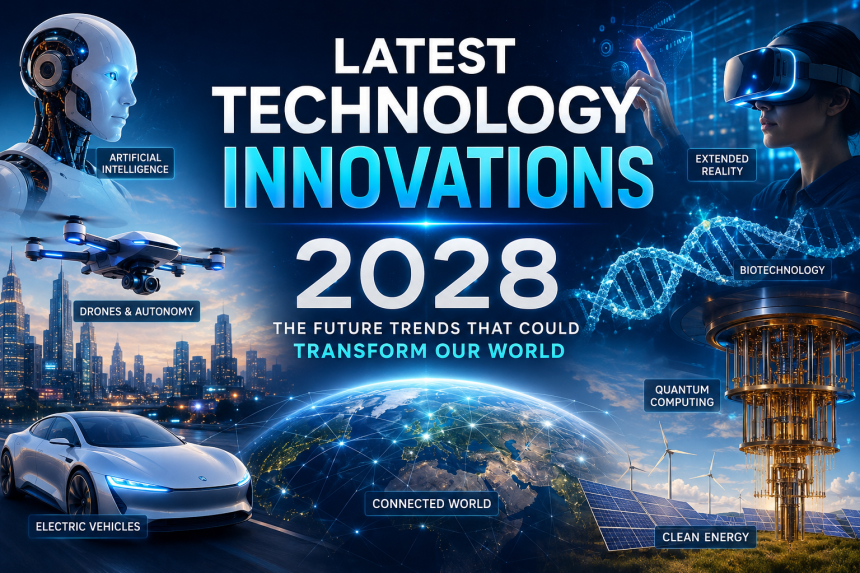
Technology continues to move forward at an extraordinary pace. Ideas that once seemed possible only in science fiction are gradually becoming part of everyday life. Artificial intelligence can already help people write, create, search, translate, and solve problems. Robots are becoming more capable, electric vehicles are evolving, and connected devices are changing the way people interact with their homes, workplaces, and cities.
So, what could the world of technology look like in 2028?
The answer will probably not come from one magical invention. Instead, progress is likely to happen through the combination of several powerful technologies. Artificial intelligence may work alongside robotics. Faster networks could support connected vehicles and smart cities. Advanced biotechnology may improve healthcare, while new energy systems could help power an increasingly digital world.
Think of technological progress like a river. It does not always move in a straight line, and not every new idea reaches the ocean. Some technologies disappear, while others join together and become something much more powerful. By 2028, many of today’s emerging ideas could become more useful, accessible, and deeply connected to everyday life.
This article explores the latest technology innovations 2028 may bring into focus and examines how these developments could affect ordinary people, businesses, healthcare, transportation, education, entertainment, and the wider world.
Artificial Intelligence Could Become a More Capable Everyday Assistant
Artificial intelligence is likely to remain one of the most important forces shaping the technology industry. By 2028, AI systems may become better at understanding context, handling multiple tasks, and working alongside people.
The biggest change may not simply be that AI becomes “smarter.” Instead, it could become easier to use.
AI May Handle Multi-Step Tasks
Today, many digital tools complete individual tasks. You ask a question, receive an answer, and then move to the next step yourself.
Future AI assistants could manage a broader workflow.
Imagine saying, “Help me plan a business trip next month.” An advanced assistant might compare possible travel dates, review your calendar, suggest transportation, organize accommodation options, and prepare a schedule.
You would still make the important decisions, but the technology could reduce the amount of repetitive work.
This could be useful for students, professionals, families, and small businesses.
Personal AI Could Become More Context-Aware
Future assistants may also understand user preferences more effectively.
Your digital tools could remember how you organize information, which tasks you perform regularly, or what type of recommendations you usually prefer.
However, this development will also raise serious questions about privacy. The more personalized a system becomes, the more important it will be to understand what information is being collected and how it is protected.
Robots Could Move Beyond Factories and Warehouses
Robots have been used in manufacturing for decades, but newer machines are becoming more flexible.
Instead of performing only one repetitive action, advanced robots may learn to handle a wider range of physical tasks.
By 2028, robotics could become more visible in public spaces, workplaces, and possibly homes.
Service Robots Could Become More Common
Robots may assist in hotels, hospitals, warehouses, retail stores, and other environments.
A robot might carry supplies through a hospital, move inventory inside a warehouse, or assist employees with repetitive physical work.
These machines may not look like the human-shaped robots often seen in movies. Many practical robots are designed specifically for a particular task.
The important question will be simple: Can the robot perform a useful job safely and reliably?
Humanoid Robots Could Continue Developing
Human-shaped robots are attracting attention because they are designed to operate in spaces built for people.
Our workplaces contain doors, stairs, shelves, tools, and equipment designed for human hands and bodies. A humanoid robot could potentially interact with these environments without requiring everything to be redesigned.
Still, widespread adoption will depend on cost, battery life, safety, maintenance, and real-world performance.
The technology may advance quickly, but replacing human flexibility remains an extremely difficult challenge.
Smartphones Could Evolve Into More Intelligent Personal Devices
The smartphone is unlikely to disappear by 2028. However, the way we use it could change.
For many people, smartphones already act as cameras, navigation tools, payment devices, entertainment centers, and communication platforms.
The next stage may focus more heavily on intelligence.
More Processing Could Happen Directly on Devices
Instead of sending every request to a remote server, future phones may perform more AI processing directly on the device.
This could improve speed and allow certain features to work without a constant internet connection.
Potential benefits include:
- Faster responses
- Improved privacy for some tasks
- Offline translation
- Intelligent photo editing
- Personalized assistance
- Reduced delays
This approach could make smartphones feel more responsive and independent.
New Form Factors May Gain Attention
Foldable phones, flexible screens, wearable displays, and smart glasses may continue to develop.
Some users may prefer a traditional smartphone, while others may choose devices that can expand into larger screens or provide information through lightweight wearables.
The future may not be about replacing one device with another. It may be about giving people more choices.
Healthcare Technology Could Become More Predictive and Personalized
Healthcare could experience some of the most meaningful technology changes in the coming years.
The goal may increasingly shift from reacting to health problems after they appear to identifying possible warning signs earlier.
Wearables Could Monitor More Everyday Health Signals
Smartwatches, rings, patches, and other wearable devices may become better at tracking physical information.
Depending on the device and its approved features, future technology could monitor areas such as:
- Activity levels
- Sleep patterns
- Heart-related signals
- Body temperature changes
- Recovery patterns
- Stress indicators
The value of this information may come from identifying changes over time.
For example, a device may notice that your usual sleep pattern has changed significantly and encourage you to pay attention.
These tools can support awareness, but they should not replace professional medical advice.
AI Could Assist Medical Research
Artificial intelligence may help researchers analyze complex medical information more quickly.
It could support areas such as medical imaging, drug discovery, data analysis, and pattern recognition.
Doctors and researchers would still need to evaluate the results. AI can process information quickly, but medical decisions require expertise, responsibility, and an understanding of the individual patient.
Extended Reality Could Become More Useful and Less Noticeable
Virtual reality, augmented reality, and mixed reality may continue developing into more practical tools.
The biggest challenge has often been the hardware. Bulky headsets can be expensive and uncomfortable for long periods.
By 2028, companies may focus on making immersive devices lighter, more efficient, and easier to use.
Smart Glasses Could Deliver Information Naturally
Imagine walking through an unfamiliar city while navigation instructions appear in your field of view.
Or imagine attending a meeting where live translation helps you understand another language.
Smart glasses could eventually provide information without requiring people to constantly check their phones.
The success of these devices will depend on comfort, privacy, battery life, and whether they solve real problems.
Learning and Training Could Become More Immersive
Extended reality may also change education and professional training.
Students could explore virtual historical locations. Engineers could practice complex procedures in simulated environments. Medical trainees could interact with detailed digital models.
This could make learning more practical and engaging.
Electric Vehicles and Smarter Transportation Could Keep Advancing
Transportation is becoming more connected and software-driven.
Electric vehicles are improving, while sensors and advanced software are making cars more capable of assisting drivers.
By 2028, the focus may increasingly move toward making transportation more efficient and convenient.
Battery Improvements Could Increase Practicality
Battery technology remains one of the most important areas of development.
Future improvements could focus on:
- Faster charging
- Longer driving range
- Improved durability
- Lower production costs
- Better safety
These changes could benefit not only cars but also electric buses, scooters, bicycles, and other forms of transportation.
Connected Vehicles Could Communicate More Effectively
Vehicles may increasingly connect with mobile applications, charging systems, navigation platforms, and traffic networks.
A connected car could receive information about traffic conditions, charging availability, or possible road hazards.
However, increased connectivity also creates cybersecurity challenges. A vehicle is becoming more like a computer network on wheels, which means digital security will be essential.
Quantum Computing Could Reach Important New Milestones
Quantum computing remains one of the most advanced and experimental areas of modern technology.
Unlike traditional computers, quantum systems use different principles to process certain types of information.
This does not mean that everyone will replace their laptop with a quantum computer.
Instead, these machines could eventually be used for specialized problems that are extremely difficult for traditional systems.
Potential Applications Could Expand
Researchers are exploring possible uses in areas such as:
- Drug development
- Material science
- Complex simulations
- Logistics
- Optimization
- Advanced research
For example, quantum systems could eventually help researchers model complex chemical interactions more effectively.
However, this technology still faces major engineering challenges.
Progress may be significant by 2028, but widespread consumer use is unlikely.
Clean Energy Technology Could Become More Important
As the world becomes increasingly dependent on electricity, energy technology will continue to play a major role in innovation.
Artificial intelligence, data centers, electric transportation, and connected devices all require power.
This makes efficient and reliable energy systems increasingly important.
Better Energy Storage Could Support Renewable Power
Solar and wind energy depend on natural conditions.
The sun does not shine at night, and wind conditions can change.
Improved energy storage could help balance these differences by storing electricity when production is high and making it available later.
Future battery systems and alternative storage technologies may help make renewable energy more flexible.
Smart Grids Could Improve Energy Management
Traditional electricity systems were designed around large power plants sending energy in one direction.
Modern energy networks are becoming more complex.
Homes may generate solar power. Electric vehicles may connect to the grid. Batteries may store electricity locally.
Smart software and connected sensors could help manage these changing energy flows more efficiently.
Biotechnology Could Open New Doors in Medicine and Food
Biotechnology combines science, biology, and advanced tools to solve problems.
By 2028, progress in this field could influence healthcare, agriculture, food production, and environmental research.
Personalized Medicine Could Continue Growing
People do not always respond to treatments in exactly the same way.
Future medical research may increasingly focus on individual differences.
More personalized approaches could help healthcare professionals select treatments based on a person’s unique characteristics and medical information.
This does not mean every treatment will become completely customized, but medicine may become more precise in certain areas.
Technology Could Improve Food Production
Agriculture may increasingly rely on sensors, drones, automation, and data analysis.
Farmers could use technology to monitor:
- Soil conditions
- Water use
- Crop health
- Weather patterns
- Pest activity
The goal is to use resources more efficiently while improving productivity.
As global demand for food increases, smarter farming could become increasingly valuable.
Cybersecurity Could Become a Daily Priority
As more of our lives move online, cybersecurity will become even more important.
People now manage banking, shopping, work, communication, healthcare information, and entertainment through connected services.
A single weak password or convincing scam can create serious problems.
AI Could Improve Security and Create New Risks
Artificial intelligence can help identify suspicious activity and detect unusual patterns.
However, the same technology may also help criminals create more convincing phishing messages, fake voices, or manipulated images.
This could make digital awareness increasingly important.
Users may need to pay closer attention to:
- Suspicious links
- Unexpected messages
- Fake websites
- Deepfake content
- Account permissions
- Password security
Passwords May Become Less Important
Traditional passwords can be difficult to remember and easy to reuse.
Future security systems may increasingly rely on passkeys, biometric verification, trusted devices, and stronger forms of digital identity.
The goal will be to make security both stronger and easier to use.
Smart Homes and Smart Cities Could Become Better Connected
Connected technology may become less visible but more useful.
Instead of controlling every device manually, people may expect systems to work together automatically.
Homes Could Become More Responsive
A connected home could adjust lighting, temperature, and energy use based on routines.
For example, a system could recognize that everyone has left the house and reduce unnecessary electricity consumption.
Security devices could send important alerts while filtering out routine activity.
The best smart home may not be the one with the most gadgets. It may be the one that quietly makes life easier.
Cities Could Use Data More Effectively
Smart city systems could help manage traffic, public transportation, waste collection, water systems, and energy.
Traffic signals might respond to real-time congestion rather than using the same schedule throughout the day.
Sensors could help identify infrastructure problems before they become major failures.
These technologies could improve urban living, but they will need strong privacy rules and responsible management.
The Future of Work Could Become More Collaborative
The rise of AI and automation has created understandable concerns about employment.
Will machines replace people?
The reality is likely to be more complicated.
Some tasks may be automated, while new types of jobs may appear.
AI Could Become a Standard Workplace Tool
Many professionals may use AI in the same way they currently use spreadsheets, search engines, or email.
Writers could use intelligent tools for research. Designers could explore concepts. Businesses could analyze customer feedback.
The most important skill may not be competing with technology but learning how to use it effectively.
Human Skills Will Still Matter
Technology can process information quickly, but human skills remain essential.
Creativity, empathy, communication, leadership, and critical thinking are difficult to automate completely.
Future workplaces may place greater value on people who can combine technical tools with human judgment.
Rather than a contest between people and machines, the future may increasingly involve cooperation.
Entertainment Could Become More Interactive
Technology may also change how people watch, play, listen, and create.
Streaming, gaming, virtual worlds, AI-generated content, and immersive experiences could continue evolving.
More Personalized Entertainment
Entertainment platforms may become better at understanding preferences.
Instead of simply recommending popular content, future systems could adapt recommendations based on mood, interests, or previous activity.
Users may also have more control over interactive experiences.
Creators Could Gain New Tools
AI and advanced software could make video editing, music production, animation, and game development more accessible.
A small creator may gain access to tools that once required a large studio.
However, this will also raise important questions about copyright, ownership, authenticity, and the value of human creativity.
Technology Will Need to Earn Public Trust
Innovation is exciting, but new technology also creates challenges.
A powerful tool is not automatically a positive one.
The way it is designed, controlled, and used matters.
Privacy Will Remain Essential
People may increasingly ask:
Who has access to my information?
How long is it stored?
Can I delete it?
Can I control how it is used?
Companies and governments will face continued pressure to provide clearer answers.
Authenticity Could Become a Major Issue
As AI-generated text, images, video, and audio become more realistic, identifying authentic content may become harder.
Technology for verification and content authentication could become increasingly important.
In the future, trust may become one of the most valuable features a technology company can offer.
How People Can Prepare for the Technology of 2028
You do not need to become a scientist, programmer, or engineer to prepare for future innovation.
A few practical habits can make a big difference.
Stay Curious and Keep Learning
Try new tools when they offer a real benefit.
Learn the basics of artificial intelligence, digital privacy, cybersecurity, and connected devices.
You do not need to understand everything. Even basic knowledge can help you make better decisions.
Protect Your Digital Life
Use strong authentication methods, keep important software updated, and be cautious about suspicious messages.
Technology is becoming more advanced, but scams are evolving too.
Focus on Adaptability
The most valuable skill may be the ability to learn and adjust.
You may not need to master every new gadget.
Instead, learn how to evaluate technology and decide whether it is useful for you.
Conclusion
The latest technology innovations 2028 could bring will likely focus on making digital tools more intelligent, connected, efficient, and personalized. Artificial intelligence may become a more capable assistant, robots could handle a wider range of tasks, healthcare could become more predictive, and clean energy systems may become increasingly important.
At the same time, innovation will bring serious questions about privacy, security, employment, and trust.
The future of technology is not simply about faster machines or more advanced gadgets. It is about how these tools fit into human life.
The most successful innovations may be the ones that solve real problems without making life more complicated. As we move closer to 2028, the goal should not be technology for the sake of technology. It should be progress that helps people live, work, learn, and connect in better ways.
Frequently Asked Questions
1. What are the biggest technology trends expected in 2028?
Artificial intelligence, robotics, smart devices, healthcare technology, electric transportation, extended reality, biotechnology, clean energy, cybersecurity, and advanced computing are likely to remain important areas of development.
2. Will AI become more powerful by 2028?
AI is expected to continue improving, particularly in areas such as automation, personalization, multimodal interaction, and task assistance. However, progress will depend on technical, economic, legal, and ethical factors.
3. Will robots become common in everyday life by 2028?
Robots may become more common in workplaces, logistics, healthcare, retail, and other specialized environments. Household robots could also improve, although fully capable general-purpose robots may still face challenges.
4. How could technology improve healthcare by 2028?
Wearable devices, AI-assisted analysis, remote monitoring, personalized treatments, and biotechnology could help healthcare professionals collect information, identify patterns, and develop more targeted approaches.
5. What skills will be important in the future technology world?
Digital literacy, adaptability, critical thinking, creativity, communication, and cybersecurity awareness are likely to become increasingly valuable as technology continues to change.